Dwarka Expressway Flats with an OC: 2, 3, and 4 BHK Prices in Ready Societies (2026)
Quick answer: Portal listings from 2026 put flats with an Occupation Certificate (OC) on Dwarka Expressway at about ₹41–70 lakh in Signature Global Grand IVA (Sector 103) and ₹2.31–4.48 Cr for 3–4 BHK in Emaar Gurgaon Greens (Sector 102). These are asking prices, not developer price lists. Confirm the OC covers your tower before you pay. Key takeaways Dwarka Expressway flats with an Occupation Certificate (OC) are the ones you can legally move into now, with no handover date to wait for. This guide covers the societies where we hold evidence of an OC, what 2, 3 and 4 BHK homes are listed at, and how to check an OC yourself before paying. KMA Global Properties has its office on Dwarka Expressway in Sector 106. All prices below are asking prices from named portals, with the month. They are not developer price lists, and they exclude stamp duty, registration, and society charges. What is an OC, and how is it different from “ready to move”? An Occupation Certificate (OC) is the authority’s written confirmation that a building was completed as per the approved plans and can be lived in. “Ready to move” is a listing label, not a legal document. The short version for a phone call: no, “ready to move” does not prove an OC. Ask for the certificate and check that it names your tower. For a buyer, the OC is one part of the due-diligence process, not a substitute for checking ownership, dues, or the physical condition of the flat. Before deciding, match the certificate to the exact tower and confirm that the unit being sold is the same one described in the sale documents. Also ask whether any alterations have been made to the flat and whether they are reflected in the approved records. A Completion Certificate (CC) confirms construction matches the sanctioned plans. The OC confirms the building is fit to occupy. Both terms are defined in Section 2 of the Real Estate (Regulation and Development) Act, 2016 [VERIFY: clause and Haryana practice on which document DTCP issues]. A part OC covers only some towers or phases. If your tower is not named on it, your flat has no OC, even when the society next door does. As of 24 Oct 2026, our records show an OC for Signature Global Grand Iva (Sector 103, received in 2021, per RealtyNMore, Apr 2021) and Emaar Gurgaon Greens (Sector 102, OC dated 16 Jul 2019 in a Haryana Real Estate Regulatory Authority order of 28 Jan 2025. Which Dwarka Expressway flats have an OC in 2026? Two societies have an OC in our records. Four more are listed as ready to move, but we have not seen their OC. The tables keep the two groups apart. OC held in our records Society (sector) HRERA registration OC Size Listed price Signature Global Grand Iva (103) HRERA project page, temp project ID RERA-GRG-PROJ-386-2019. Registration no.: [VERIFY: one portal lists “13 of 2017”] Received 2021 1,472 units on 9 acres, affordable housing policy; 1 and 2 BHK per portal listings [VERIFY] ₹40 Lakh – ₹1.25 Crore Emaar Gurgaon Greens (102) 36(a) of 2017, dated 5 Dec 2017, per an HRERA order of 28 Jan 2025 [VERIFY: HRERA portal copy] 16 Jul 2019 (same order); DTCP licence 75 of 2012 672 units on 13.53 acres; towers of 14 floors; one 3 BHK in the order is 1,650 sq ft super area 3–4 BHK ₹2.31–4.48 Cr (PropertyBouquet, Sep 2026) Listed as ready to move; OC not yet checked by KMA Society (sector) HRERA registration OC Listed price Godrej Summit (104) HRERA project page. Registration no.: 75 of 2017; one portal lists RERA-GRG-653-2020 An HRERA complaint record states an OC dated 7 Apr 2017. Tower coverage not confirmed: September 2018 (Overall Possession) 3 BHK ₹1.48–1.66 Cr (HomeBazaar, Oct 2026) Puri Emerald Bay (104) 136 of 2017 November 21, 2018 ₹2.30 Cr to ₹3.92 Cr ATS Triumph (104) GGM/1051/783/2026/23 May 29, 2019 ₹2.88 Cr to ₹6.30 Cr Hero Homes (104) RC/REP/HARERA/GGM/2018/24 January 20, 2025 Between ₹1.62 Cr and ₹4.00 Cr Godrej Summit shows why the tower matters. HRERA also holds a separate 2020 registration application for the project, marked “ongoing” (temp project ID RERA-GRG-PROJ-653-2020). A society can hold an OC for some towers and not others, so a project-level “ready” label settles nothing. Grand Iva, Sector 103: good for first-time buyers working to a budget under ₹70 lakh. Not for buyers who want free resale, since affordable housing flats can carry transfer conditions. Gurgaon Greens, Sector 102: good for families who want a larger home in a society with a high tower count. Not for buyers under ₹2.3 Cr. How much do Dwarka Expressway flats cost per sq ft in 2026? ANAROCK data reported on 11 Sep 2026 puts the average price on the corridor at ₹14,180 per sq ft in H1 2026, up from ₹6,032 in 2021. The Gurugram average is ₹13,350 per sq ft (ANAROCK via The Realty Today, 11 Sep 2026). That is a rise of about 135% in five years (₹14,180 ÷ ₹6,032 = 2.35). ANAROCK also counts 10,770 unsold homes, about 18 months of sales at the current pace. A slower pace gives buyers time to compare and negotiate. It does not tell you where prices go next. BHK Share of supply (ANAROCK via The Realty Today, 11 Sep 2026) 1 BHK 6% 2 BHK 27% 3 BHK 39% 4 BHK and above 28% Ready societies can price below that average. Godrej Summit’s listed 3 BHK homes work out to about ₹9,000 per sq ft, roughly 36% under ₹14,180. Treat this as a rough pointer only. The average covers newer projects, and the area basis may differ. What does a 3 BHK in Dwarka Expressway cost in a ready society? In the one society where we have a dated 3 BHK price, Godrej Summit in Sector 104, listings run ₹1.48–1.66 Cr for 1,647–1,844 sq ft (HomeBazaar, Oct 2026). Ready-to-move 3 BHK flats in Dwarka Expressway are also the largest
Sector 102 vs 103 vs 104 Dwarka Expressway: Which sector suits you in 2026?
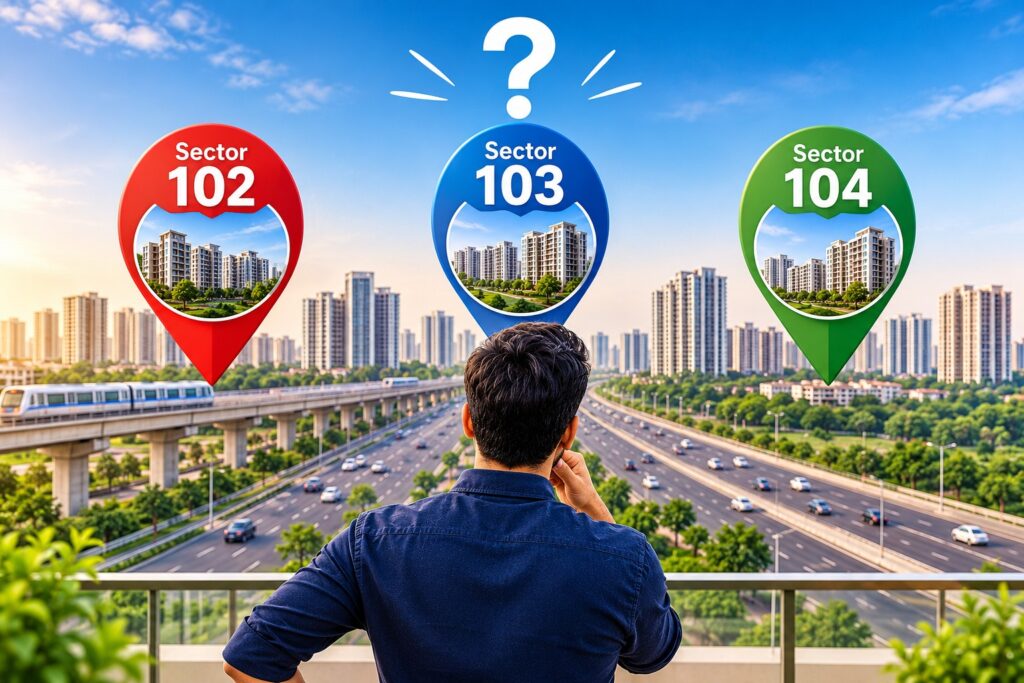
Quick answer: Choose Sector 104 Dwarka Expressway if you want a finished flat now or steady rent, because it has the largest group of occupied societies of the three. Choose Sector 103 Dwarka Expressway if your budget is under ₹1 crore, since Signature Global Grand IVA still trades in that range. Choose Sector 102 Dwarka Expressway if you can wait for a new tower: its main launches have HRERA completion dates between October 2028 and December 2032. In June 2026, resale asking prices averaged about ₹14,000 per sq ft in 104 and ₹12,000 in 103 (SquareYards), while new launches across these sectors are priced well above that. Why the price per sq ft looks so different on every website Search for Sector 102 Dwarka Expressway prices, and you’ll see figures anywhere from ₹9,000 to ₹22,000 per sq ft. Both ends can be right, because they describe different stock. Older resale flats sell for far less per sq ft than new towers. A 3 BHK of about 1,650–1,840 sq ft in Godrej Summit, Sector 104, was listed at ₹1.48–1.66 crore on HomeBazaar in October 2026, which works out to roughly ₹9,000 per sq ft. Adani’s new tower, The Marq, in Sectors 102 and 102A, was quoted at about ₹16,500 per sq ft in January 2026 (TogetherBuying). Sobha’s September 2026 guide quotes ₹17,052–21,011 per sq ft for Sector 102 Dwarka Expressway and Sector 103 together, and ₹22,172 for 104, which reflects new launches. So ask one question before comparing any two numbers: is this a resale flat or a new launch? The table below keeps the two apart. The three sectors side by side Sector 102 Sector 103 Sector 104 Resale asking price, average Not reported ₹12,000/sq ft (SquareYards, Jun 2026) ₹14,000/sq ft (SquareYards, Jun 2026) Average 3 BHK rent Not reported ₹34,650 a month ₹44,550 a month What’s on sale Mostly new launches, plus Emaar Gurgaon Greens Affordable ready flats and luxury launches Mostly finished societies Main new projects (HRERA completion) HCBS Twin Horizon (Oct 2028), BPTP Amstoria Verti Greens (Jun 2032), BPTP Gaia Residences (Dec 2032) Godrej Vrikshya (Jun 2031), AIPL Riviera (2030) Indiabulls Estate & Club I (Oct 2029), Hero Homes The Palatial, Tower E (Dec 2029) Collector rate for flats, 2026-27 Check the tehsil file Check the tehsil file ₹7,700/sq ft Portals don’t yet report reliable resale or rent averages for Sector 102 Dwarka Expressway, because most of its homes aren’t built. Sector 102 Dwarka Expressway: for buyers who can wait Most homes for sale in Sector 102 Dwarka Expressway are still under construction. The one large finished society is Emaar Gurgaon Greens: 27 towers of 14 floors on 13.53 acres, with about 672 flats and an occupation certificate. Resale 3 and 4 BHK flats there were listed at about ₹2.31–4.48 crore in September 2026 (PropertyBouquet). The new projects in Sector 102 Dwarka Expressway, with dates taken from their HRERA registrations: Project HRERA No. Size Completion on HRERA HCBS Twin Horizon GGM/948/680/2025/51 268 flats in 2 towers 15 Oct 2028 BPTP 102 Eden Estate III (plots) GGM/940/672/2025/43 126 plots 27 Nov 2029 BPTP Amstoria Verti Greens GGM/910/642/2025/13 885 flats in 5 towers 14 Jun 2032 BPTP Gaia Residences GGM/963/695/2025/66 3 towers 31 Dec 2032 Adani The Marq (Sectors 102 and 102A) GGM/1042/774/2026/14 2 towers of 46 floors see HRERA Two of the BPTP projects in Sector 102 Dwarka Expressway carry completion dates in 2032. If you book today, plan for six years of instalments before you get the keys, and keep paying rent or an EMI on your current home until then. Read the quarterly progress report on the HRERA site before each payment demand. Our comparison of ready-to-move and under-construction homes goes through that cost in detail. Gurugram Global Heights School is inside Sector 102 Dwarka Expressway, and Sheetla Mata Hospital is about 3–5 km away (PropertyBouquet). Sector 102 Dwarka Expressway is also the only one of the three with a new plotted project, BPTP’s Eden Estate III. Sector 103 Dwarka Expressway: the widest price range Sector 103 Dwarka Expressway has homes at both ends of the market within the same few streets. At the low end is Signature Global Grand IVA, a 9-acre society of 1,472 flats built under Haryana’s Affordable Housing Policy. It received its occupation certificate in 2021 and was listed at about ₹41–70 lakh in 2026 (SquareYards). Flats under that policy are small, so compare carpet area, not the super area shown on listings. At the high end, Godrej Vrikshya (HRERA GGM/846/578/2024/73) has an HRERA completion date of 30 June 2031. AIPL Riviera at Lake City is due in 2030 and was listed at ₹3.62–5.60 crore in mid-2026. Whiteland’s Westin Residences is also in this sector, but portals show two different registration numbers and possession dates for it, so take both from the HRERA site before you book. That spread is why the sector average of ₹12,000 per sq ft hides more than it shows. A 2 BHK rented for about ₹20,000 a month in June 2026 and a 3 BHK for ₹34,650. Signum 103, a ready retail block, gives residents shops close by. If you buy here in a woman’s name, the savings are easy to see. On a ₹60-lakh flat, stamp duty is ₹4.2 lakh at the 7% rate for men and ₹3 lakh at the 5% rate for women, provided the agreed price is above the collector value. Sector 104 Dwarka Expressway: For moving in or renting out now Sector 104 Dwarka Expressway is the most lived-in of the three. Godrej Summit, ATS Triumph, Hero Homes and Puri Emerald Bay are all finished. Puri Emerald Bay was registered with HRERA on 28 August 2017 (registration 136 of 2017), so this part of the road has had residents for years. Rents reflect that. A 3 BHK in Sector 104 Dwarka Expressway averaged ₹44,550 a month in June 2026, about ₹10,000 more than in 103. A 2 BHK averaged ₹23,850. SquareYards puts the sector’s gross rental yield at about 2.4%. New
Pre-leased Property in Gurgaon: 7 Lease Checks Before You Buy (2026)

Quick answer: A pre-leased property in Gurgaon is a shop, office, or showroom sold with a tenant already paying rent, so your income starts on the day of registry. Before you pay, check seven things: who the tenant is, how much lock-in is left, whether the rent is at market level, whether the lease is registered, what happens to the security deposit, your net yield after costs, and the title and approvals of the building. Most deals we see on Dwarka Expressway give a gross yield of about 6–7.5%. The figure that matters is the net yield after stamp duty, property tax, and any months without a tenant. Key takeaways What is a pre-leased property? It’s a commercial unit that already has a tenant on a signed lease when you buy it. The lease moves to you with the property. From the registry date, the tenant pays rent to you instead of the seller. People also search for it as “pre-rented property”. In Gurgaon, a pre-leased property is usually one of these: It is different from an “assured return” unit. With assured return, the developer promises you a monthly payout, often before the building is finished. With pre-leased property, a real tenant is in the space, and the rent comes from their business. More on that difference further down. Why buyers are looking at pre-leased property in Gurgaon in 2026 Office demand in the region picked up sharply this year. Colliers India reported 8.3 million sq ft of Grade A office leasing in Delhi NCR between January and September 2026. In the July–September quarter alone, NCR leased 3.3 million sq ft, more than twice the 1.6 million sq ft of the same quarter in 2025. Across the seven big office markets, average rents rose about 7% year-on-year in that quarter (Colliers India, via PropNewsTime, 3 October 2026). More leasing means more companies signing leases, and some of those leased units come up for sale. That is why the number of pre-leased listings on Golf Course Extension Road, Sohna Road and Dwarka Expressway has grown. A busier market also means more poorly checked deals, which is where the seven checks below come in. 7 checks before you buy pre-leased property in Gurgaon 1. Who is the tenant, and can they keep paying? The tenant is the asset. A national pharmacy chain on a ground-floor shop is a very different risk from a two-year-old startup on an upper floor. Ask the seller for: If the tenant is a franchisee, find out whether the lease is signed by the brand or by the local franchise company. Only the company named in the lease is bound to pay. 2. How much lock-in is left? During the lock-in, neither side can end the lease without paying a penalty, usually the rent for the unexpired lock-in. After it ends, the tenant can normally leave with a notice period of one to six months. Many buyers read “nine-year lease” and stop there. Check the start date and the lock-in clause together. A lease with a three-year lock-in that began in 2023 gives you no protection in 2026. Banks look at the same thing. Kotak’s lease rental discounting criteria ask for at least two years of lease term remaining. 3. Is the rent at market level? An inflated rent is the most common trap when you buy pre-rented property in Gurgaon. A seller can rent the unit to a related company at a high rent, sell it on a “high yield”, and the tenant leaves when the lock-in ends. Compare the rent per sq ft with two or three similar units in the same building or street. Ask the brokers active in that market what an empty unit of the same size would rent for today. If the rent in the lease is far above that, assume it will fall when the lease is renewed and price the property on the lower figure. Also read the escalation clause. A common pattern in Gurgaon is a 15% rise every three years, or about 5% a year. Escalation helps you only if the tenant stays. 4. Is the lease registered and properly stamped? Under Section 17 of the Registration Act, 1908, a lease of immovable property for more than one year must be registered. Haryana also charges stamp duty on a lease, worked out on the average annual rent, and the rate goes up with the length of the lease. An unregistered long lease is a weak document. If the tenant stops paying or refuses to vacate, you may struggle to enforce its terms in court. Ask for the registered copy with the sub-registrar’s endorsement, not a notarised print. 5. What happens to the security deposit? Most commercial tenants in Gurgaon pay a deposit of three to six months’ rent. It was paid to the seller, but when the lease ends, the tenant will ask you for it. There are two clean ways to handle it: Get it written into the sale deed. You also need an attornment letter, where the tenant confirms in writing that you are the new landlord and that rent will now come to your account. 6. What is your net yield after costs? Sellers quote gross yield: yearly rent divided by the sale price. Your real return is lower. Work it out on the total cost, after these: Two tax points catch new owners out. The first is TDS. If the rent is above ₹50,000 a month, a company tenant deducts 10% TDS before paying you. You get credit for it when you file your return, but your monthly cash credit is lower. The second is GST. Commercial rent attracts 18% GST. You must register once your total turnover crosses ₹20 lakh a year. If you are unregistered and your tenant is registered, the tenant pays the GST under reverse charge. That rule came into effect on 10 October 2024. Composition-scheme tenants were taken out of it from 16 January 2025 (Notification 07/2025-Central Tax
Property Registration Charges in Gurgaon 2026: Stamp Duty, Fees, and A Worked Example

Quick answer: Property registration charges in Gurgaon have two parts. Stamp duty is 7% for men, 5% for women, and 6% for a man and woman buying jointly, inside municipal limits. The registration fee rises in slabs to a cap of ₹50,000 for anything above ₹90 lakh. A man buying a ₹2 Cr flat pays about ₹14.5 lakh in total. Key takeaways What is the stamp duty in Gurgaon in 2026? Stamp duty is the larger part of registration charges in Gurgaon. For a sale deed, it is 7% for a man, 5% for a woman, and 6% for joint ownership by a man and a woman, if the property is inside municipal limits. Outside municipal limits, the rates drop to 5%, 3%, and 4%. These are the rates Haryana applies to conveyance deeds, and DLF, Godrej Capital, and ClearTax all list the same figures in their 2026 guides. Buyer Inside municipal limits Outside municipal limits Man 7% 5% Woman 5% 3% Man and woman jointly 6% 4% Which column you fall in depends on location. Most sector housing in Gurugram is inside municipal limits, but a few villages and peripheral areas are not. If you’re unsure, the stamp duty calculator on the Haryana e-registration portal tells you which rate applies once you enter the property’s location. How much is the registration fee in Gurgaon? The registration fee is the smaller part of registration charges in Gurgaon, and it’s a fixed amount by value slab, not a percentage. For any property above ₹90 lakh, it is ₹50,000, which covers almost every flat sold in Gurugram today. The higher slabs were set by the Haryana Cabinet in September 2018, and we found no later change. Property value Registration fee ₹25 lakh to ₹30 lakh ₹15,000 ₹30 lakh to ₹40 lakh ₹20,000 ₹40 lakh to ₹50 lakh ₹25,000 ₹50 lakh to ₹60 lakh ₹30,000 ₹60 lakh to ₹70 lakh ₹35,000 ₹70 lakh to ₹80 lakh ₹40,000 ₹80 lakh to ₹90 lakh ₹45,000 Above ₹90 lakh ₹50,000 Below ₹25 lakh, the fees are smaller (₹100 up to ₹12,500), though published guides disagree on the exact cut-offs. Some websites still say Gurgaon’s registration fee is “1%” or a flat “₹15,000”. Neither is right for a property above ₹30 lakh. Why do the 2026-27 collector rates matter? Registration charges in Gurgaon are worked out on the higher of two numbers: your agreement value or the collector rate value. The collector rate (also called the circle rate) is the minimum value the district sets for each area. If it is higher than your price, you pay duty on the collector rate. Gurugram’s new collector rates for 2026-27 came into force on 1 April 2026, according to the Deputy Commissioner’s office. The proposals published in March showed the biggest jump on Dwarka Expressway: Dwarka Expressway (Sectors 104–115) Before 2026-27 (proposed) Group housing flats ~₹4,200 per sq ft ₹7,000 per sq ft Residential plots ₹40,000–44,000 per sq yd ₹66,125–70,000 per sq yd Source: The Tribune, 29 March 2026 (proposed rates). The final list, “Final Collector Rates for 2026”, is published by Haryana’s Urban Local Bodies department (official PDF). Check the row for your sector before you pay. New-launch buyers rarely see higher registration charges in Gurgaon from this, because developer prices on the expressway sit well above ₹7,000 per sq ft. Resale buyers are a different story. A flat that changes hands at a discount, or an older tower priced near the collector rate, can now attract duty on a value higher than the deal. Our Dwarka Expressway property prices guide shows where current asking prices sit against the new rate. Buying on Dwarka Expressway? Send us the sector and flat size, and a KMA adviser will work out your stamp duty and registration fee at the 2026-27 rates. Call or WhatsApp +91-9056560022. How do you calculate registry charges in Gurgaon? Take the higher of your agreement value and the collector rate value, multiply it by your stamp duty rate, then add the registration fee for that value. That sum is your total registration charges in Gurgaon. In steps: As a formula: registration charges in Gurgaon = (higher of agreement or collector value × stamp duty rate) + registration fee. The calculator on the Haryana e-registration portal does the same sum before you pay. How much will you pay? Worked examples Here are the property registration charges in Gurgaon for three common budgets, assuming the property is inside municipal limits, and the agreement value is above the collector value. If you’re budgeting around ₹2 Cr, see what ₹2 crore buys on Dwarka Expressway. Property value Man (7%) Woman (5%) Joint (6%) ₹1 Cr ₹7,00,000 + ₹50,000 = ₹7.5 lakh ₹5,00,000 + ₹50,000 = ₹5.5 lakh ₹6,00,000 + ₹50,000 = ₹6.5 lakh ₹2 Cr ₹14,00,000 + ₹50,000 = ₹14.5 lakh ₹10,00,000 + ₹50,000 = ₹10.5 lakh ₹12,00,000 + ₹50,000 = ₹12.5 lakh ₹3.5 Cr ₹24,50,000 + ₹50,000 = ₹25 lakh ₹17,50,000 + ₹50,000 = ₹18 lakh ₹21,00,000 + ₹50,000 = ₹21.5 lakh A resale case where the collector rate wins (illustrative): say you agree to ₹95 lakh for a 1,400 sq ft resale flat on Dwarka Expressway. At ₹7,000 per sq ft, the collector value is ₹98 lakh. Your registration charges in Gurgaon are then worked out on ₹98 lakh, not ₹95 lakh. Item Amount Collector value (1,400 × ₹7,000) ₹98,00,000 Stamp duty at 7% (man) ₹6,86,000 Registration fee ₹50,000 Total ₹7,36,000 Extra versus paying on ₹95 lakh ₹21,000 Check which area (carpet, built-up, or super area) the collector rate list uses for your tower, because that changes the answer. How does paperless registration work now? Registration charges in Gurgaon are now paid online. Since 1 November 2025, every sale deed in Haryana is registered through the paperless e-registration system. A second version with automatic mutation went live on 23 June 2026, so the land record now updates without a separate application. The system isn’t instant. In August 2026, Gurugram had 6,018 paperless applications waiting for the applicant
NA Plot Meaning: How to Check NA Status Before Buying a Plot in Maharashtra (2026)

Quick Answer: An NA plot is land approved for non-agricultural use, such as building a house, shop, or office. In Maharashtra, the rules changed on 31 December 2025. Where the Development or Regional Plan allows the use, an approved building permission plus a one-time premium now counts as NA permission. A separate Collector’s NA order is no longer needed. Key Takeaways What does NA plot meaning? The NA plot meaning is simple: NA stands for Non-Agricultural, so an NA plot is land whose use has been legally changed from farming to purposes such as housing, commerce, or industry. In India, land is usually recorded as agricultural unless the revenue records show otherwise. You can legally build a house only on land approved for that use. Point Agricultural land NA plot Permitted use Farming Housing, shops, offices, industry (as the plan allows) Building a house Not allowed without conversion Allowed with building permission Who can buy (Maharashtra) Mainly agriculturists (Section 63, Maharashtra Tenancy and Agricultural Lands Act, 1948) Any Indian buyer; NRIs and OCIs too Home loan Generally not available Available against approved plans 7/12 extract shows Agricultural use (“शेती”) Non-agricultural use (“बिनशेती”) Good for: Anyone planning to build a home or hold a plot in a gated layout. Not for: Buyers looking for farmland, which follows different rules. What changed for NA plots in Maharashtra in 2026? Maharashtra replaced the old NA permission system on 31 December 2025. The Maharashtra Land Revenue Code (Second Amendment) Act, 2025 deleted the old conversion sections (42A–42D, 44–46 and 47A), substituted a new Section 42 and a new Section 47, and abolished the annual NA tax (Mondaq / LegaLogic, 13 May 2026). A Government Resolution (GR) dated 10 February 2026 set out how Collectors, planning authorities and banks must apply it. Point Before 31 Dec 2025 From 31 Dec 2025 NA permission Separate order (sanad) from the Collector Not needed where the Development or Regional Plan permits the use What counts as NA permission Collector’s NA order Building permission from the Planning Authority Annual NA tax Payable every year Abolished Conversion charge Conversion tax plus NA assessment One-time premium on the Ready Reckoner value 7/12 update Separate mutation application Automatic where the digital system is linked; otherwise, the Tahsildar updates it Bank loans Banks often ask for the NA sanad GR directs banks not to insist on a sanad once permission is granted and the premium is paid Building permission is now the key NA document. Applications go online through the Building Permission Management System (BPMS) or AutoDCR, or offline where no online system exists (LawWeb, March 2026, summarising the 10 Feb 2026 GR). What did not change: the land must still be in a zone where the use is allowed. Under the new Section 42(2), building permission does not upgrade Class II or restricted land to Class I. Those landholders still need sanction from the competent authority and must pay any due nazarana (premium). What is an NA order (sanad), and do you still need one? An NA order, or sanad, was the Collector’s written permission converting a survey number from agricultural to non-agricultural use. Since 31 December 2025, new conversions in planned areas no longer need one. Brokers often call these orders “NA 42”, “NA 44” or “NA 45” after the old sections of the Maharashtra Land Revenue Code they were issued under. The 2025 Act deleted those sections. Plot converted What proves NA status Before 31 Dec 2025 The Collector’s NA order (sanad), plus proof that the one-time premium has been paid From 31 Dec 2025 Building permission or layout approval from the Planning Authority, plus the premium receipt For an older plot, check that the survey number, area and purpose on the NA order match the 7/12 extract and the layout plan. A residential NA order does not cover a commercial building. What are the types of NA plots, and is an R-zone plot the same? NA plots are classed by the use they are approved for: residential, commercial, industrial or mixed use. Building rules, such as permitted floor area and setbacks, depend on that use and on the zone in the Development or Regional Plan. Type Approved for Typical buyer NA residential Houses, villas, bungalows Families, second-home buyers NA commercial Shops, offices, hotels Business owners, investors NA industrial Factories, warehouses Manufacturers, logistics firms Mixed use A combination, as the plan allows Developers Gaothan land Village settlement area, traditionally used for housing Local buyers; check the property card An R-zone plot is not automatically an NA plot. “R-zone” means the land is marked Residential in a Development or Regional Plan, so housing is allowed there. Under the 2026 rules, the plot becomes NA once building permission is granted and the premium is paid. Until then, the 7/12 extract may still show agricultural use. How to check if a plot is NA or not in Maharashtra? To confirm an NA plot, start with the 7/12 extract, then ask the seller for the building permission and the premium receipt. The 7/12 extract (Satbara utara) is Maharashtra’s record of rights for each survey number. You can view it for free on the MahaBhumi portal. Get a free NA status check before you pay. Send the plot’s survey number and 7/12 extract to a KMA adviser. We will check the land use, occupancy class, layout approval, and MahaRERA registration, and tell you what to ask the seller. Call or WhatsApp +91-9056560022. We reply on the same working day. Which documents prove a plot is NA? For an NA plot bought in 2026, ask for these documents. Together, they prove the NA plot status on paper, not just in the brochure. Older conversions will also have an NA order from the Collector. Document What it proves Where it comes from 7/12 extract Land use, owner, occupancy class, encumbrances MahaBhumi portal 8A extract All holdings of the owner in the village MahaBhumi portal Mutation entries (ferfar), about 30 years How ownership and use changed Talathi
Best Areas to Buy Property Near Delhi Airport (2026)

The IGI Airport has silently emerged as one of the biggest real estate buzzwords in Delhi NCR, and it is not because the airport location sounds glamorous, but because it caters to one very particular, high-end problem: commute time for the man who flies a lot. Corporate executives, NRIs who regularly do the back and forth, and entrepreneurs with a national or international reach all place a huge premium on property near Delhi Airport, and that demand has completely reshaped pricing across an entire corridor. This guide dissects which sectors and corridors are worth your consideration, with actual travel times, not wishy-washy “excellent connectivity” comments, so you can decide which location suits your budget and priorities. Quick Answer Buyers who want the quickest access to the airport are primarily considering sectors 113, 111, and 106 of Dwarka Expressway. The Delhi section of Dwarka Expressway now benefits from an airport tunnel and underpass system providing faster access to IGI Airport Terminal 3, with road journeys from the nearest Gurugram sectors often estimated at around 15-20 minutes in favourable traffic conditions. Golf Course Road currently benefits from a more developed luxury scene but has a longer commute, 30+ minutes along NH-48. The best choice depends on what you’re optimizing for, in terms of travel time, lifestyle, and potential long-term investment. Why Buy Property Near IGI Airport? Beyond the obvious convenience, proximity to a major international airport tends to support real estate value in a few specific, measurable ways: 1. Dwarka Expressway — The Corridor the Tunnel Changed Quick facts: Airport tunnel and underpass connectivity to IGI · commute ~15–20 min in favourable traffic conditions · 58% YoY price growth in Q4 2024 (CREDAI-Colliers-Liases Foras) · future appreciation will depend on market conditions, infrastructure completion and project quality No single corridor has benefited from airport proximity as directly as this one. The detail most guides skip: The Delhi section of Dwarka Expressway now benefits from an airport tunnel and underpass system providing faster access to IGI Airport Terminal 3. For the nearest Gurugram sectors, road journeys can be around 15–20 minutes in favourable traffic conditions, although actual travel times vary by sector, route and traffic. This isn’t a minor upgrade. It’s arguably the single biggest reason this corridor has outperformed most other NCR markets on price growth recently. A CREDAI-Colliers-Liases Foras report put Dwarka Expressway’s year-on-year price growth at 58% in Q4 2024, one of the strongest increases among the micro-markets tracked in Delhi NCR during that period. The corridor’s future appreciation will depend on infrastructure completion, supply, project quality, buyer demand, and broader market conditions. Why buyers prioritise it: 2. Sector 113 — The Closest Premium Address to the Airport Quick facts: ~15 min to IGI Airport · on Dwarka Expressway with direct tunnel access · highest price bracket on the corridor Sector 113 sits at the near end of the expressway, closest to the Delhi border and the airport tunnel itself, commonly cited as roughly 15 minutes from IGI Airport by road. It has among the shortest airport commutes of any Gurgaon residential sector, a concentration of ultra-premium high-rise developments, and particularly strong appeal among NRIs and C-suite executives given the commute advantage. That advantage comes at a cost: correspondingly, it carries the highest price bracket on the corridor. Best fit: Buyers for whom minimising airport travel time is the top priority, frequent flyers, and relocating executives. 3. Sector 111 — Comparable Access, More Room to Grow Quick facts: ~15–20 min to IGI Airport · similar access to Sector 113 · typically lower entry price Sector 111 sits just behind Sector 113 and offers very similar airport access and commute times in the same 15–20 minute range, while typically carrying a somewhat lower entry price, Sector 113’s status as the “closest” address commands its own premium that Sector 111 doesn’t have to pay. Advantages: near-comparable airport connectivity to Sector 113, more new residential launches (and therefore more configuration choices), improving physical infrastructure, and comparatively more room for appreciation since it isn’t already priced at the corridor’s ceiling. 4. Sector 106 — Balanced for Families and Investors Quick facts: ~20–25 min to IGI Airport · larger, more spacious layouts than the ultra-premium sectors · established developer presence Sector 106 sits a bit further along the corridor and has become popular with families rather than purely investment-focused buyers, largely because larger layouts are easier to find here than in the sectors closest to the tunnel. Reasons to consider it: Direct Dwarka Expressway access with a manageable commute, established developers running larger integrated communities, greener and lower-density surroundings relative to the corridor’s densest stretches, growing social infrastructure (schools, retail, healthcare), and strong resale demand as the surrounding ecosystem matures. Frequent travellers who also want more living space for the same budget often end up here rather than in Sectors 111 or 113. 5. Sector 102 — The More Affordable Entry Point Quick facts: ~25–30 min to IGI Airport · comparatively competitive pricing on the corridor · more headroom for appreciation Sector 102 sits further along the expressway and remains one of the more accessible entry points for buyers who want airport-adjacent connectivity without paying the premium the closest sectors command. Advantages: comparatively competitive pricing within the corridor, ongoing infrastructure development and newer launches, reasonable, if not the fastest, airport access, and more room for appreciation as this sector’s infrastructure catches up to its more developed neighbours. Best fit: buyers prioritising value and future upside over the shortest possible commute. 6. Golf Course Road — Established Luxury, Slightly Further Out Quick facts: 30+ min to IGI Airport via NH-48 · mature luxury ecosystem · strongest resale market on this list Golf Course Road isn’t part of the Dwarka Expressway corridor, but it remains one of Gurugram’s most prestigious addresses, with strong overall connectivity via NH-48 and the broader road network, just not airport-optimised the way the tunnel-linked sectors are. What sets it apart: A fully evolved luxury ecosystem (luxury retail, premium schools and hospitals, well-known corporate offices), strong
Is Dwarka Expressway Overpriced in 2026? A Data-Driven Buyer Guide
Property prices on this corridor are undeniably higher than their historical levels, but “overpriced” is a verdict that needs a project name attached to it, not a blanket label for the whole stretch. Rates swing by more than ₹8,000 per sq ft between sectors, so the real question isn’t whether the corridor is expensive. It’s whether the specific property you’re looking at earns its price. Quick Answer This corridor as a whole is not uniformly overpriced, though individual projects can be. Housing.com’s 2026 locality data puts the average price at roughly ₹12,688 per sq ft, with sector averages ranging from about ₹11,098/sq ft in Sector 37D to ₹19,307/sq ft in Sector 36A, and a reported 3.52% year-on-year rise. MagicBricks’ Q2 2026 data shows a higher multi-storey apartment benchmark of roughly ₹14,661/sq ft, but a quarter-on-quarter dip of about -1%, suggesting the market isn’t rising evenly across the corridor. The honest answer: it depends entirely on which sector and which project you’re comparing. Why “Is Dwarka Expressway Overpriced?” Is the Wrong Question This corridor isn’t one market; it’s a collection of very different micro-markets sharing one address. A resale apartment at ₹11,000/sq ft and a branded luxury tower at ₹19,000/sq ft can both sit on the same road, and neither price tells you much about the other. That’s why the more useful question isn’t “Is Dwarka Expressway expensive?“ It’s: at this price, am I getting enough location, connectivity, rental demand, project quality, and future growth to justify what I’m paying? Dwarka Expressway Property Prices by Sector (2026) Sector Approx. 2026 Average Rate 37D ₹11,098/sq ft 103 ₹11,243/sq ft 109 ₹12,366/sq ft 108 ₹13,439/sq ft 102 ₹13,831/sq ft 104 ₹14,563/sq ft 112 ₹14,614/sq ft 106 ₹14,731/sq ft 111 ₹15,560/sq ft 113 ₹16,969/sq ft 36A ₹19,307/sq ft Source: Housing.com locality-level data, reviewed July/August 2026. That’s a spread of more than ₹8,000 per sq ft from the cheapest to the priciest sector, roughly a 74% gap. A ₹2 crore resale buyer and a ₹6 crore luxury buyer are effectively shopping in two different markets that happen to share a highway. Why Do People Call Dwarka Expressway Overpriced? 1. Prices have climbed sharply from where they started The corridor was formerly marketed almost entirely on future promise, on infrastructure that had not yet arrived. That promise has been mostly fulfilled: NHAI confirms that the 19km, eight-lane Haryana stretch was thrown open in March 2024, from the Delhi-Haryana border (Basai railway overbridge) to Kherki Daula, with further access to IGI Airport and the Gurugram bypass. As the infrastructure materialized, prices moved with it. The catch for today’s buyer is straightforward: you’re not entering the same market an early investor entered. Some of the appreciation that used to sit ahead of the market may already be baked into current asking rates. 2. Luxury-project pricing distorts the average in people’s heads It’s easy to mistake a handful of headline-grabbing luxury listings for the corridor’s typical price. They’re not the same thing. Current Housing.com listings (reviewed July 2026) show just how wide this gap runs: These are asking prices from active listings, not confirmed transactions, and individual units vary by floor, view, construction stage, and applicable charges. The point stands regardless: one expensive tower doesn’t make the whole corridor overpriced; it just makes that tower expensive. 3. Future growth may already be priced into some projects This is the sharper question for anyone thinking like an investor. When a location is still undeveloped, early buyers can get in before infrastructure and demand fully mature. Once the roads, connectivity, and large residential projects are already built, the price starts reflecting expectations about future development too, not just what exists today. Earlier investor 2026 investor Entry price Lower Higher Infrastructure certainty Low High Upside potential Higher, but riskier More moderate, less risky Prices can absolutely rise further from here. The point is simply that buyers today need to be more deliberate about what they’re paying now for growth that may or may not still be ahead of them. Is Dwarka Expressway Still Undervalued? There’s a real case on both sides. The case for further growth: improving Delhi–Gurugram connectivity, proximity to IGI Airport, a large residential pipeline, expanding commercial development, access to established Gurugram employment hubs, and continued developer activity. A May 2026 Times of India report, citing a joint India Sotheby’s International Realty–CRE Matrix study, described the corridor’s shift from a peripheral market toward a more integrated urban growth zone, backed by substantial value growth. The case for caution: supply is the biggest risk factor. Housing.com listed more than 4,900 flats for sale on its corridor listings page in July 2026, alongside over 2,000 new projects and thousands of resale listings. That’s not the full future pipeline, but it shows how much inventory buyers already have to choose from, and when buyers have that much choice, sellers have less room to hold pricing firm, especially if end-user demand doesn’t keep pace with new supply. The Real Trap: Asking Price vs. Actual Value An advertised rate of ₹18,000 per sq ft doesn’t automatically mean the property is worth ₹18,000 per sq ft. Before you take a headline number at face value, work through: The effective acquisition cost, not the marketing headline, is what determines whether a property is fairly priced. A 3-Step Test to Check If a Property Is Overpriced 1. Find comparable market pricing: Shortlist at least three properties in the same sector with a similar configuration, size, possession status, construction quality, developer reputation, and location within the sector. Don’t compare a five-year-old resale flat against a newly launched branded tower just because both sit in Sector 106. 2. Calculate the effective acquisition cost: A builder quoting ₹15,000 per sq ft on a 2,000 sq ft saleable-area apartment gives you a headline figure of ₹3 crore (₹15,000 × 2,000). But GST, where applicable, stamp duty, registration, parking, PLC, floor-rise, club charges, and maintenance deposits can push the real number meaningfully higher. 3. Test the income and resale case: Ask who’s realistically buying
What Can ₹2 Crore Buy on Dwarka Expressway in 2026?
A ₹2 crore budget on Dwarka Expressway doesn’t point to one type of home; it points to a decision. That same amount can land you a compact 2 BHK in a newer premium tower, a full-size 3 BHK in a value-oriented sector, a resale apartment with an established society, or an independent floor, depending on where you look and what you’re willing to trade off. Quick Answer At 2026 rates, this budget typically fetches a 2 BHK in a premium or new development, a 3 BHK in a value-driven sector or resale market, or an independent floor in a few micro-markets. The MagicBricks Q2 2026 report suggests that the average rate for multi-storey apartments on Dwarka Expressway is around ₹14,661 per square foot, with a range of ₹11,024–₹18,298 per square foot, which is also why very different homes can be had for the same amount based on sector and project. Treat ₹2 crore as your property budget, and not your overall budget: registration, stamp duty, GST, parking, club fees, add-ons. Why the Same ₹2 Crore Buys Such Different Homes The math seems straightforward until you plug it into a real hallway with prices that vary widely. At this rate, the budget translates to just under 1,364 sq ft. However, that’s a benchmark, and not a booking; the rates vary depending on how the developer defines the area, and the cost itself includes floor-rise charges, PLC, parking, club fees, taxes, and registration, etc. Doing the same math with the lower end of the range for that locality, about ₹12,000 per sq. It gets smaller at the high end: around ₹16,000 per sq. ft., and is equal to 1,250 sq. ft. That gap, more than 400 sq ft on the same money, is the entire story of why sector selection matters as much as the number on the cheque. Your Main Options at ₹2 Crore 1. A 2 BHK in a Premium Project Quick facts: Example listing — Agrante Vanmaya Premium Residences, Sector 106 · 2 BHK · approx. ₹1.97 crore · approx. ₹13.89K/sq ft (Housing.com) If developer reputation, amenities, and a more finished residential environment matter more to you than raw square footage, this budget can get you into a 2 BHK in a genuinely premium, newer project. The Agrante Vanmaya example in Sector 106 is a useful illustration of how this budget positions in newer developments, but treat it as one listing, not a sector-wide price. Before you book anything at this level, confirm: A ₹1.97 crore base price has room to cross ₹2 crore once these are added in. 2. A 3 BHK in a Value-Oriented Sector Quick facts: Example listings — Sector 104 3 BHK: approx. ₹88.9 lakh–₹1.85 crore · Sector 37D resale independent floor: approx. ₹1.4 crore (Housing.com) If usable space matters more than brand positioning, the same money can go significantly further in a value-oriented sector or the resale market. Listings in Sector 104 show 3 BHK inventory well under this price point, and Sector 37D has resale independent floors near ₹1.4 crore. The real trade-off is: a premium project with a smaller footprint vs. a larger footprint in a less-established micro-market. There isn’t a universally correct answer, only the one that fits your priorities. 3. A Resale 3 BHK Quick facts: Example listing — Sector 99A resale independent floor · approx. 1,600 sq ft · approx. ₹1.8 crore (Housing.com) Resale has one advantage no brochure can replicate: you can inspect the actual building instead of trusting a sample flat and a rendering. That means you can personally check construction quality, society maintenance, occupancy levels, parking, noise, water supply, power backup, internal roads, and rental demand before you commit. A ₹1.8 crore, 1,600 sq ft independent floor in Sector 99A is one example of what this can look like again, a single listing rather than a sector benchmark. What ₹2 Crore Buys, Sector by Sector Sector What ₹2 Crore Tends to Get You 37D Comparatively lower entry price; larger 3 BHK configurations possible; project quality varies, so vet individually 103 Delhi-side positioning; often a resale-vs-new-launch trade-off at this budget 102 Established residential belt; evaluate by project and possession, not sector average 106 Increasingly premium; this budget often lands a 2 BHK rather than a 3 BHK (e.g., Agrante Vanmaya) 111 Mixed price points; don’t assume this budget automatically secures a premium 3 BHK 113 One of the more premium locations; fewer large-configuration choices at this budget ₹2 Crore: 2 BHK or 3 BHK? Priority Better Fit Maximum space 3 BHK, value-oriented segment Premium project/amenities 2 BHK Family end-use 3 BHK Rental flexibility Depends on micro-location and tenant demand Lower entry price Resale or value segment New construction 2 BHK or compact 3 BHK Immediate possession Resale / ready-to-move Long-term lifestyle Premium project, even if smaller There’s no universal winner here. A 1,200 sq ft 3 BHK in a weaker-managed project isn’t automatically better than a 1,100 sq ft 2 BHK in a well-run community — usable space, project quality, location, resale liquidity, and total ownership cost all factor in together. Is a 3 BHK Under ₹2 Crore Realistic? Yes, but availability is sector- and listing-dependent. Housing.com’s current inventory shows 3 BHK options below ₹1.5 crore in parts of the corridor, including Sector 104 and Sector 37D, and a ₹1.8 crore independent floor in Sector 99A. At the same time, newer premium 3 BHK projects are already priced well above ₹2 crore; Kashish Manor One in Sector 111, for instance, currently lists around ₹3 crore. “3 BHK under ₹2 crore” is achievable. “Premium new-launch 3 BHK under ₹2 crore” is a much narrower search. What about a 4 BHK under ₹2 Crore? Set expectations here carefully. This budget generally isn’t the natural price band for a spacious, premium 4 BHK on Dwarka Expressway. If you do come across a listing at this level, dig into the carpet area, built-up area, project age, exact location, construction status, developer, and any additional charges before assuming it’s a genuine bargain. If a
New Residential Projects on Dwarka Expressway (2026 Guide): Prices, Sectors & What Buyers Should Check
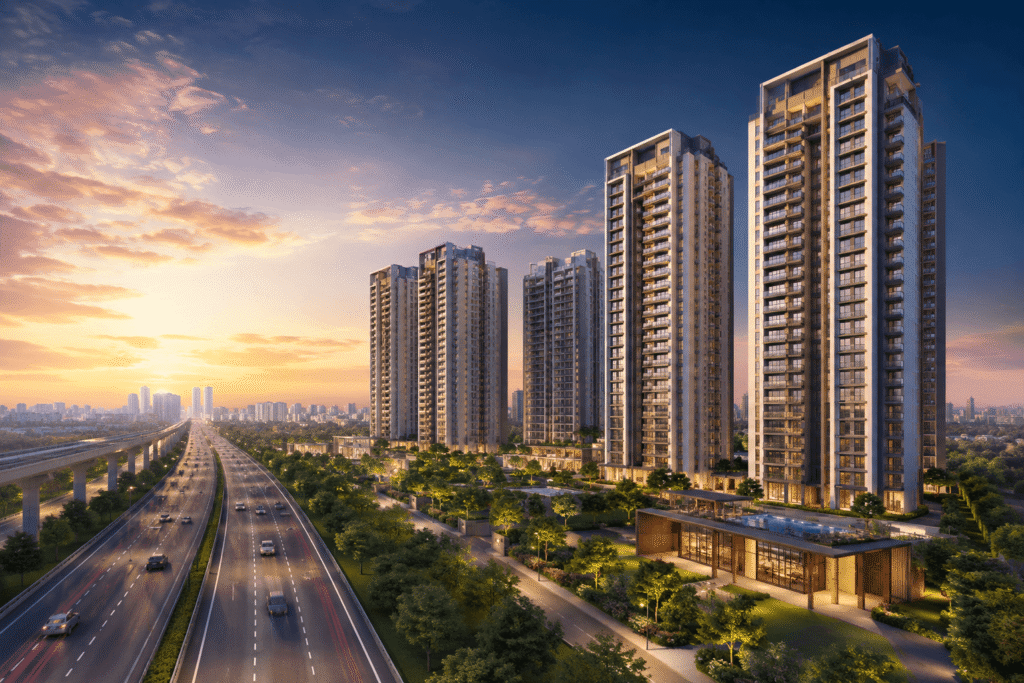
Dwarka Expressway has stopped being a “wait and watch” corridor. The road is open, Delhi–Gurugram travel time has dropped, and a wave of premium housing has followed. This guide breaks down which new residential projects are actually worth your attention in 2026, and how to tell a genuine new launch from an old project with a fresh coat of marketing. Quick Answer If you only have a minute, the 2026 launch pipeline on Dwarka Expressway is led by Godrej Vrikshya and Whiteland Westin Residences in Sector 103, Central Park Delphine in Sector 104, and BPTP Amstoria Verti Greens in Sector 102. Ultra-luxury buyers are also tracking Elan The Presidential (Sector 106), M3M Crown (Sector 111), and MVN Aero One (Sector 37D). Configurations run from 2 BHK to large 4–5 BHK homes, with entry prices roughly between ₹2.5 crore and ₹10 crore-plus, depending on the project, floor, and phase. This is a premium-to-luxury market; very few new launches on this stretch are targeting the entry-level buyer. Why Is Dwarka Expressway Suddenly Full of New Launches? The short answer: infrastructure caught up with the promise. The Haryana stretch of Dwarka Expressway opened in March 2024, giving Delhi and Gurugram an eight-lane connection. The Delhi-side stretch followed in August 2025 as part of a larger NCR infrastructure push. Until then, most buyers were purchasing based on future connectivity. Now they’re buying on current connectivity, and developers have responded by pushing more premium and luxury inventory into the corridor. The broader Gurugram market backs this up. ANAROCK data cited by The Economic Times shows a sharp rise in Gurugram residential prices between 2019 and Q2 2026. Layer on the government’s planned Global City Gurugram, a large mixed-use business district, and you get a corridor where developers are betting on long-term demand rather than quick flips. New Residential Projects on Dwarka Expressway — 2026 Snapshot Project Sector Configuration Positioning RERA Status Godrej Vrikshya 103 3 & 4 BHK Premium / Luxury Registered Whiteland Westin Residences 103 3 & 4 BHK Branded Luxury Registered Central Park Delphine 104 Luxury residences/studios Premium / Luxury Multiple phases registered BPTP Amstoria Verti Greens 102 2 & 3 BHK Premium Registered Elan The Presidential 106 3, 4 & 5 BHK Ultra Luxury Registered M3M Crown 111 3 & 4 BHK Luxury Registered MVN Aero One 37D Large-format luxury Ultra Luxury Registered A quick caveat worth repeating: not everything in this table is a fresh 2026 launch. Some are recently launched projects; others simply have active new inventory or a new phase releasing in 2026. A project can stay “under construction” for years after its original launch date, so the label matters less than the actual construction and RERA status. Project-by-Project Breakdown 1. Godrej Vrikshya, Sector 103 — nature-led premium living Quick facts: Developer: Godrej Properties · Configuration: 3 & 4 BHK · Starting price: ₹3.81 crore onwards · Possession: June 2031 · RERA: RC/REP/HARERA/GGM/846/578/2024/73 Godrej Vrikshya is currently one of the most talked-about launches on this stretch of the expressway. Godrej Properties markets it around a nature-first concept, over 800 trees, a one-acre forest trail, and a clubhouse spread across more than 55,000 sq ft. Pricing starts at ₹3.81 crore for 3 and 4 BHK homes. Good fit for: buyers who want a large, established developer name and don’t mind a possession date that stretches to 2031. This is a long-hold purchase, not a quick-turnaround one. 2. Whiteland Westin Residences, Sector 103 — branded, hospitality-style homes Quick facts: Developer: Whiteland Corporation · Brand tie-up: Westin · Configuration: 3 & 4 BHK · RERA: RC/REP/HARERA/GGM/838/570/2024/65, 66, 67 (plus later phase registrations) This project sits in the same sector as Godrej Vrikshya but plays a different game, branded residences with a hospitality feel rather than a straightforward apartment product. Whiteland has also announced construction tie-ups with Kalpataru Projects International and Ahluwalia Contracts. The real question to ask is: branded homes almost always carry a price premium over their surroundings. Before booking, work out whether that premium is justified against comparable luxury stock nearby, not whether the project itself “feels” luxurious. 3. Central Park Delphine, Sector 104 — new supply in an established pocket Quick facts: Developer: Central Park · Configuration: Luxury residences and studios · RERA: RC/REP/HARERA/GGM/996/728/2025/99, /997/729/2025/100, /998/730/2025/101 (three phases) Sector 104 already has a reputation as a mature premium pocket, so Delphine is entering a location with proven demand rather than an early-stage sector. Central Park’s official listings highlight access to Delhi, Gurugram’s business hubs, IGI Airport, and the Dwarka Sector 25 metro corridor. Good fit for: buyers who want a genuinely new project but would rather not bet on an unproven micro-market. 4. BPTP Amstoria Verti Greens, Sector 102 — the more accessible entry point Quick facts: Developer: BPTP · Configuration: 2 & 3 BHK · RERA: RC/REP/HARERA/GGM/910/642/2025/13 Not everyone shopping on Dwarka Expressway wants, or can justify, a ₹5–10 crore ticket size. Verti Greens, part of BPTP’s larger Amstoria development, offers 2 and 3 BHK homes, which puts it structurally apart from the ultra-luxury launches on this list. Don’t compare it in isolation. Weigh price per sq ft, actual carpet area, possession date, maintenance cost, and resale liquidity, not just the headline BHK configuration. 5. Elan The Presidential, Sector 106 — for the ultra-luxury buyer Quick facts: Developer: Elan · Configuration: 3, 4 & 5 BHK · Market listings (MagicBricks): approx. ₹4.65 crore–₹7.77 crore · RERA: RERA-GRG-PROJ-1194-2022 Sector 106 has become one of the corridor’s premium residential clusters, and Elan The Presidential sits firmly at the top of it, with 3, 4, and 5 BHK inventory currently listed across a wide price band. Worth remembering: a large price gap between two similar-looking luxury projects doesn’t automatically mean the pricier one appreciates faster. Entry price still matters, even at this end of the market. 6. M3M Crown, Sector 111 — luxury with a Delhi-side edge Quick facts: Developer: M3M India · Configuration: 3 & 4 BHK · Location advantage: closer to the Delhi side of the corridor Sector
Best Builders in Gurgaon (2026): Compared by Delivery, Trust & ROI
Gurgaon has become one of India’s most closely watched real estate markets, and it pulls in homebuyers, NRIs, and investors from well beyond the NCR. But the mistake that consistently costs buyers the most isn’t choosing the wrong sector or floor plan; it’s selecting a project without properly evaluating the developer behind it.The developer you choose shapes almost everything that happens after you sign: whether possession happens on schedule, whether construction quality holds up ten years in, whether the project resells well, and whether tenants actually want to live there. This guide compares the best builders and top real estate developers in Gurgaon across four practical criteria, so you’re comparing developers on substance rather than on which one has the flashiest launch campaign this quarter. Quick Answer: Who Are the Best Builders in Gurgaon? DLF is generally considered the benchmark developer in Gurgaon due to its long market presence, premium portfolio, and resale ecosystem. Godrej Properties, Sobha, M3M, Emaar, ATS, Experion, and Signature Global are also among the developers frequently considered by buyers depending on budget, location preference, and investment goals. How We Compared the Builders This isn’t based on advertising spend or launch hype. Four factors form the basis of this comparison: A note on how to read this: these comparisons reflect general market reputation and publicly available track record, not an exhaustive audit of every project each developer has built. Individual projects from even top-tier developers vary; always verify the specific project’s HRERA status and documentation independently before booking. Quick Comparison: Top Builders in Gurgaon Builder Founded Best For Delivery Trust Construction DLF 1946 Luxury, NRIs, long-term investors ★★★★★ ★★★★★ ★★★★★ Godrej Properties 1990 Premium family living ★★★★☆ ★★★★★ ★★★★☆ Sobha Limited 1995 Engineering-led luxury ★★★★☆ ★★★★☆ ★★★★★ M3M India 2007 High-growth luxury corridors ★★★★☆ ★★★★☆ ★★★★☆ Signature Global 2014 First-time & mid-income buyers ★★★★☆ ★★★★☆ ★★★★☆ Experion Developers 2006 Premium end-users ★★★★☆ ★★★★☆ ★★★★☆ Emaar India 2005 International-standard townships ★★★★☆ ★★★★☆ ★★★★☆ ATS Group 1998 Reliable mid-to-premium execution ★★★★☆ ★★★★☆ ★★★★★ Bestech Group 1990 New Gurgaon, family communities ★★★★☆ ★★★☆☆ ★★★★☆ Smart World Developers 2021 Tech-led homes, younger buyers ★★★☆☆ ★★★☆☆ ★★★★☆ Methodology Note: This comparison is based on publicly available information, market reputation, project delivery history, portfolio quality, and buyer perception. Ratings represent an editorial assessment and should not replace project-level due diligence. Ratings indicate relative market positioning based on editorial assessment, not independently verified numerical scores. 1. DLF — The Benchmark of Gurgaon Real Estate Overview: DLF is effectively synonymous with modern Gurgaon. Founded in 1946 and originally focused on Delhi’s residential colonies, the company expanded significantly into Gurgaon during the late 20th century as Delhi faced increasing land constraints and Gurgaon emerged as a major private real estate destination. This expansion played a major role in shaping Gurgaon’s modern real estate landscape. From DLF Phases 1–5 to Cyber City and Golf Course Road, there’s barely a premium Gurgaon corridor DLF hasn’t influenced. Why DLF leads: Popular Projects: DLF Privana, The Camellias, The Arbour, The Crest, The Magnolias, The Aralias Best For: Luxury buyers, long-term investors, NRIs, premium rental income Buyers should still verify project-specific HRERA details and agreements independently, but DLF is often considered one of the more established developer choices in Gurgaon due to its long operating history and resale ecosystem. 2. Godrej Properties Overview: Godrej Properties carries the weight of the broader Godrej Group’s 125-plus-year legacy, while operating as a more modern, design-forward developer in its own right. The company itself was established in 1990 and has built a national reputation for sustainability-focused development. Strengths: Popular Projects: Godrej Aristocrat, Godrej Miraya, Godrej Air Best For: Premium apartments, family living, long-term appreciation Independent buyer feedback generally places Godrej among the most trusted premium developers active in Gurgaon, though — as with any developer — delivery performance should be checked project by project rather than assumed from brand reputation alone. 3. Sobha Limited Overview: Sobha built its reputation on construction engineering rather than marketing. Founded in 1995 by PNC Menon, Sobha went public in 2006, reflecting the market confidence it had built before expanding further across India. Why buyers prefer Sobha: Suitable For: Luxury buyers, self-use homes, long-term investment 4. M3M India Overview: Founded in 2007, M3M has grown quickly into one of Gurgaon’s most visible luxury developers, with a portfolio concentrated heavily along Golf Course Extension Road and Dwarka Expressway, two of the city’s fastest-appreciating corridors. Strengths: Popular Projects: M3M Altitude, M3M Mansion, M3M Capital, M3M Golf Estate Extension Suitable For: Luxury investors, buyers targeting high-growth corridors Because M3M’s growth has been rapid, buyer confidence tends to depend more heavily on project-specific execution than it does for older, more established developers. Due diligence is therefore more important than relying on brand recognition alone. 5. Signature Global Overview: Signature Global built its early reputation in affordable housing before expanding successfully into the premium segment, a transition that has expanded its presence beyond affordable housing into the premium residential segment. Strengths: Popular Projects: Signature Global City, Signature Daxin, Signature Titanium Best For: First-time buyers, mid-income investors, affordable luxury The company has strengthened its credibility meaningfully in recent years, but as with any developer expanding quickly into a new segment, buyers should review individual project timelines and approvals rather than assuming consistency across its full portfolio. 6. Experion Developers Overview: Experion has international investment backing and has positioned itself around premium residential developments with spacious layouts, lifestyle-focused planning, and a lower-volume development approach compared with many large-scale developers. Strengths: Popular Projects: Windchants, The Heartsong, The Trillion Best For: End-users, premium family living 7. Emaar India Overview: Emaar brings international township development experience into Gurgaon, and it shows in the landscaping and master-planning of its communities, a different design sensibility from most domestic developers. Advantages: Popular Projects: Emaar Palm Hills, Emaar Gurgaon Greens, Emaar Digihomes Best For: Buyers wanting international-standard township living 8. ATS Group Overview: Founded in 1998 under Getamber Anand’s leadership, ATS has built a reputation less on flashy branding and more on consistent