Dwarka Expressway vs SPR vs New Gurgaon: Best Investment in 2026
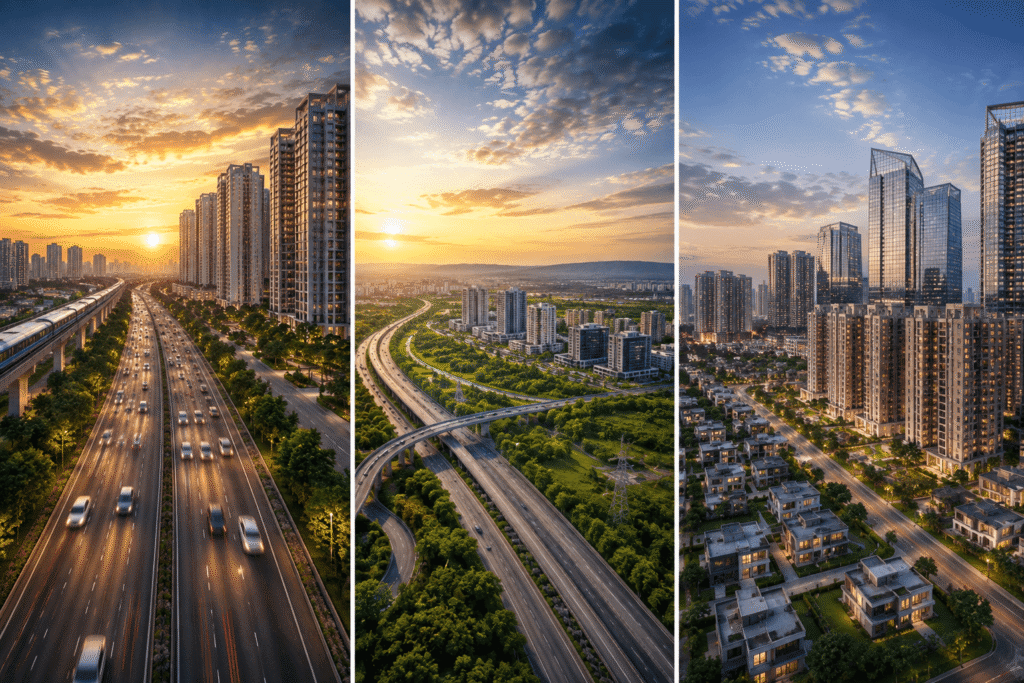
Three corridors, three completely different investment stories. Dwarka Expressway, Southern Peripheral Road (SPR), and New Gurgaon all get lumped together as “Gurugram real estate,” but they don’t compete for the same buyer. The right question isn’t which one is best overall; it’s which one matches your budget, horizon, and reason for buying. Quick Answer There’s no single winner among these three corridors; it comes down to what you’re optimizing for. Dwarka Expressway suits investors chasing long-term capital appreciation and Delhi/airport connectivity, with Housing.com pricing it at roughly ₹12,688/sq ft. SPR fits buyers who want established demand and stronger rental depth, priced higher at roughly ₹16,919/sq ft. New Gurgaon offers the lowest entry point of the three, around ₹11,582/sq ft, with reported year-on-year growth of about 14.1%, good for buyers prioritizing affordability and a longer runway. These are Housing.com locality benchmarks; MagicBricks’ Q2 2026 data runs somewhat higher for Dwarka Expressway (~₹14,661/sq ft) and SPR (~₹18,027/sq ft), so treat all figures as indicative, not fixed. At a Glance Factor Dwarka Expressway SPR New Gurgaon Current price positioning Mid to premium Premium Lower to mid Market maturity Developing/maturing More established Developing Capital appreciation potential High, but project-specific Moderate to high High, but location-specific Rental demand Growing Stronger in established pockets Moderate to growing Entry affordability Moderate Lower affordability Relatively better Airport/Delhi connectivity Strong Moderate Moderate Resale liquidity Improving Relatively stronger Varies by project Best suited for Growth-focused investors Balanced investors/end-users Early-growth investors Key risk Paying a premium for future potential Higher entry price Micro-market and supply selection This is a qualitative investment framework, not a forecast of returns. Current Prices Across the Three Corridors (2026) Price comparisons only mean something with context attached, so here’s each corridor on its own terms before we put them side by side. Dwarka Expressway: Housing.com’s 2026 locality data for Dwarka Expressway shows an average of about ₹12,688/sq ft, with sector-specific rates varying between approximately ₹11,098/sq ft in Sector 37D to ₹19,307/sq ft in Sector 36A (Sector 102: ~₹13,831; Sector 104: ~₹14,563; Sector 106: ~₹14,731; Sector 113: ~₹16,969). MagicBricks Q2 2026 4BHK price on property per sq ft prices in locality is as low as approx. ₹11,024 and as high as ₹18,298/sq ft. Southern Peripheral Road (SPR): Housing.com 2026 The average is around ₹16,919 per square foot with a min-max range of ₹9,615 to ₹28,888 per sq ft. MagicBricks’ Q2 2026 data reveals that high-rises in particular earn about ₹18,027/sq ft, with the locality range ranging up to approximately ₹22,336/sq ft. That premium is all about a more mature residential ecosystem and access to existing jobs and lifestyle hubs. New Gurgaon: Housing.com’s current data puts the average at approximately ₹11,582/sq ft, with reported year-on-year growth of around 14.1%. Worth flagging: “New Gurgaon” is a broad label, and pricing between sectors and projects varies a lot — a Sector 81–85 project isn’t directly comparable to one closer to Manesar. The pattern: New Gurgaon has the lowest average entry point of the three; this corridor sits in the middle, and SPR commands the highest average pricing. A lower price, though, doesn’t automatically translate into higher future returns. Why Dwarka Expressway Is a Different Kind of Bet This corridor’s investment story is built almost entirely on infrastructure and connectivity. It links Gurugram to Delhi, provides access to NH-48, and sits close to IGI Airport and the wider Delhi-NCR network. It’s also matured past being a purely speculative “future corridor,” with real residential and commercial development now on the ground. That maturity comes with a caveat: not every project here will appreciate at the same rate. A ₹12,000/sq ft project and an ₹18,000/sq ft project can sit on the same stretch of road while differing completely in developer profile, construction stage, apartment size, density, rental demand, resale liquidity, competing future supply, and effective acquisition cost. This corridor may suit you if you: The mistake buyers make here is treating the whole road as one investment. The project matters more than the road name. Why SPR Commands a Premium SPR’s edge isn’t future potential; it’s present-day maturity. Several pockets already sit inside an established residential and commercial ecosystem around Golf Course Extension Road, Sohna Road, and other major employment corridors, and current pricing (~₹16,919/sq ft on Housing.com, ~₹18,027/sq ft on MagicBricks for multi-storey apartments) reflects that. The trade-off is straightforward: you pay more upfront, in exchange for established neighbourhoods, existing occupancy, proximity to employment hubs, stronger rental depth in select pockets, more developed social infrastructure, and deeper end-user demand. The catch: because prices already start higher, entry discipline matters even more here. A good project bought at a fair valuation is a very different investment than an expensive unit bought purely on the strength of the corridor’s brand name. SPR may suit you if you: Why New Gurgaon Deserves More Attention Than It Gets This micro-market tends to get overlooked simply because it lacks the premium branding of the other two; that’s arguably a mistake. Housing.com’s current data shows an average of approximately ₹11,582/sq ft with roughly 14.1% year-on-year growth, and the appeal is the combination of relative affordability with a large residential catchment, plus connectivity toward NH-48, Manesar, and other employment areas. The label is broader than the other two, though differences between sectors, projects, and developers here can be substantial, so “New Gurgaon” alone isn’t specific enough to base a decision on. This micro-market may suit you if you: For end-users specifically, it also offers a broader spread of configurations and price points to choose from. Which Has Better Connectivity? Each corridor’s connectivity strength points in a different direction: There’s no single winner; the “best” connectivity depends entirely on where you actually need to go. Which Has Better Rental Potential? Rental yield and capital appreciation are two separate questions; a property can appreciate well while producing modest rent, or generate solid rent without delivering standout appreciation. SPR currently has an edge in select pockets thanks to established occupancy and proximity to employment centres. This expressway’s rental market is still developing as more
Is Dwarka Expressway Overpriced in 2026? A Data-Driven Buyer Guide
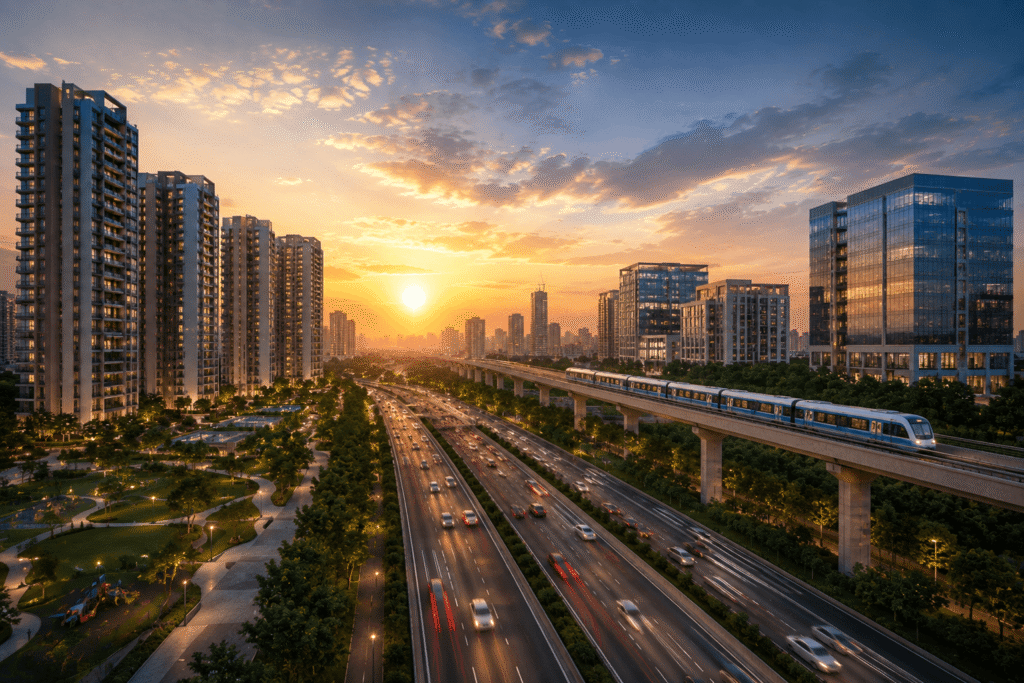
Property prices on this corridor are undeniably higher than their historical levels, but “overpriced” is a verdict that needs a project name attached to it, not a blanket label for the whole stretch. Rates swing by more than ₹8,000 per sq ft between sectors, so the real question isn’t whether the corridor is expensive. It’s whether the specific property you’re looking at earns its price. Quick Answer This corridor as a whole is not uniformly overpriced, though individual projects can be. Housing.com’s 2026 locality data puts the average price at roughly ₹12,688 per sq ft, with sector averages ranging from about ₹11,098/sq ft in Sector 37D to ₹19,307/sq ft in Sector 36A, and a reported 3.52% year-on-year rise. MagicBricks’ Q2 2026 data shows a higher multi-storey apartment benchmark of roughly ₹14,661/sq ft, but a quarter-on-quarter dip of about -1%, suggesting the market isn’t rising evenly across the corridor. The honest answer: it depends entirely on which sector and which project you’re comparing. Why “Is Dwarka Expressway Overpriced?” Is the Wrong Question This corridor isn’t one market; it’s a collection of very different micro-markets sharing one address. A resale apartment at ₹11,000/sq ft and a branded luxury tower at ₹19,000/sq ft can both sit on the same road, and neither price tells you much about the other. That’s why the more useful question isn’t “Is Dwarka Expressway expensive?“ It’s: at this price, am I getting enough location, connectivity, rental demand, project quality, and future growth to justify what I’m paying? Dwarka Expressway Property Prices by Sector (2026) Sector Approx. 2026 Average Rate 37D ₹11,098/sq ft 103 ₹11,243/sq ft 109 ₹12,366/sq ft 108 ₹13,439/sq ft 102 ₹13,831/sq ft 104 ₹14,563/sq ft 112 ₹14,614/sq ft 106 ₹14,731/sq ft 111 ₹15,560/sq ft 113 ₹16,969/sq ft 36A ₹19,307/sq ft Source: Housing.com locality-level data, reviewed July/August 2026. That’s a spread of more than ₹8,000 per sq ft from the cheapest to the priciest sector, roughly a 74% gap. A ₹2 crore resale buyer and a ₹6 crore luxury buyer are effectively shopping in two different markets that happen to share a highway. Why Do People Call Dwarka Expressway Overpriced? 1. Prices have climbed sharply from where they started The corridor was formerly marketed almost entirely on future promise, on infrastructure that had not yet arrived. That promise has been mostly fulfilled: NHAI confirms that the 19km, eight-lane Haryana stretch was thrown open in March 2024, from the Delhi-Haryana border (Basai railway overbridge) to Kherki Daula, with further access to IGI Airport and the Gurugram bypass. As the infrastructure materialized, prices moved with it. The catch for today’s buyer is straightforward: you’re not entering the same market an early investor entered. Some of the appreciation that used to sit ahead of the market may already be baked into current asking rates. 2. Luxury-project pricing distorts the average in people’s heads It’s easy to mistake a handful of headline-grabbing luxury listings for the corridor’s typical price. They’re not the same thing. Current Housing.com listings (reviewed July 2026) show just how wide this gap runs: These are asking prices from active listings, not confirmed transactions, and individual units vary by floor, view, construction stage, and applicable charges. The point stands regardless: one expensive tower doesn’t make the whole corridor overpriced; it just makes that tower expensive. 3. Future growth may already be priced into some projects This is the sharper question for anyone thinking like an investor. When a location is still undeveloped, early buyers can get in before infrastructure and demand fully mature. Once the roads, connectivity, and large residential projects are already built, the price starts reflecting expectations about future development too, not just what exists today. Earlier investor 2026 investor Entry price Lower Higher Infrastructure certainty Low High Upside potential Higher, but riskier More moderate, less risky Prices can absolutely rise further from here. The point is simply that buyers today need to be more deliberate about what they’re paying now for growth that may or may not still be ahead of them. Is Dwarka Expressway Still Undervalued? There’s a real case on both sides. The case for further growth: improving Delhi–Gurugram connectivity, proximity to IGI Airport, a large residential pipeline, expanding commercial development, access to established Gurugram employment hubs, and continued developer activity. A May 2026 Times of India report, citing a joint India Sotheby’s International Realty–CRE Matrix study, described the corridor’s shift from a peripheral market toward a more integrated urban growth zone, backed by substantial value growth. The case for caution: supply is the biggest risk factor. Housing.com listed more than 4,900 flats for sale on its corridor listings page in July 2026, alongside over 2,000 new projects and thousands of resale listings. That’s not the full future pipeline, but it shows how much inventory buyers already have to choose from, and when buyers have that much choice, sellers have less room to hold pricing firm, especially if end-user demand doesn’t keep pace with new supply. The Real Trap: Asking Price vs. Actual Value An advertised rate of ₹18,000 per sq ft doesn’t automatically mean the property is worth ₹18,000 per sq ft. Before you take a headline number at face value, work through: The effective acquisition cost, not the marketing headline, is what determines whether a property is fairly priced. A 3-Step Test to Check If a Property Is Overpriced 1. Find comparable market pricing: Shortlist at least three properties in the same sector with a similar configuration, size, possession status, construction quality, developer reputation, and location within the sector. Don’t compare a five-year-old resale flat against a newly launched branded tower just because both sit in Sector 106. 2. Calculate the effective acquisition cost: A builder quoting ₹15,000 per sq ft on a 2,000 sq ft saleable-area apartment gives you a headline figure of ₹3 crore (₹15,000 × 2,000). But GST, where applicable, stamp duty, registration, parking, PLC, floor-rise, club charges, and maintenance deposits can push the real number meaningfully higher. 3. Test the income and resale case: Ask who’s realistically buying
Why Dwarka Expressway Is the Best Real Estate Investment Destination In 2026
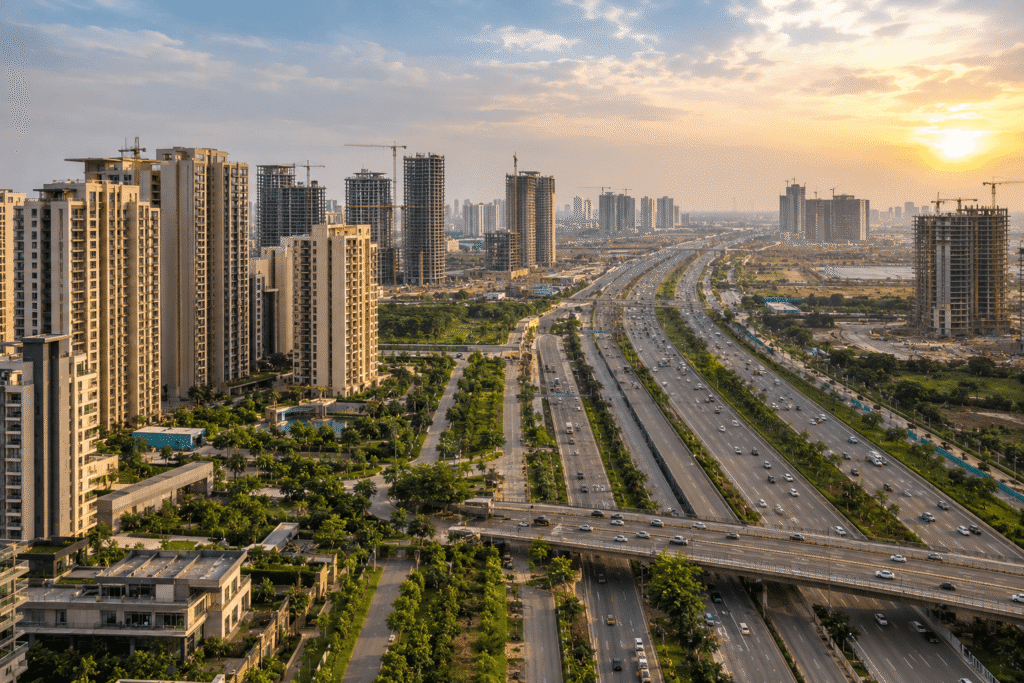
Quick answer: If you’re weighing where to put money into Gurugram real estate this year, Dwarka Expressway is hard to ignore. ANAROCK’s numbers put average residential prices at around ₹4,730 per sq. ft. in 2015, climbing to roughly ₹12,300 per sq. ft. by Q1 2025, close to 160% appreciation in a decade. The 29-km access-controlled expressway is largely functional now; it connects straight into Delhi, IGI Airport, NH-48, and SPR, and developers like DLF, M3M, Godrej Properties, Sobha, Signature Global, and Smart World have all planted flags along the corridor. Good fit for first-time buyers, rental investors, and NRIs alike, though as with any market, the sector and builder you pick will matter as much as the corridor itself. A decade ago, Dwarka Expressway was mostly a construction site with a lot of promise attached to it. That’s no longer the case. The road infrastructure connecting it to Delhi and the airport is largely built, the housing stock has gone distinctly upmarket, and commercial activity has picked up enough that it’s stopped feeling like a bedroom community waiting to happen and started feeling like an actual neighbourhood. Below is what’s actually driving that shift, and a few things worth checking before you commit money to it. Why Invest in Dwarka Expressway – At a Glance Factor Why It Matters Connectivity Faster access to Delhi, IGI Airport, and business districts Infrastructure Government-backed road and metro projects support long-term growth Property Appreciation Strong demand and limited premium inventory support value growth Rental Demand Corporate professionals and families drive consistent demand Lifestyle Schools, hospitals, malls, and entertainment improve liveability How It Stacks Up Against Other Gurugram Corridors Location Appreciation Rental Demand Connectivity Investment Potential Dwarka Expressway High High Excellent Excellent Golf Course Road Stable High Excellent Premium New Gurgaon Medium Medium Good Growing SPR High Medium Excellent High Where Is Dwarka Expressway, Exactly? The Northern Peripheral Road, also known as the NPR, is a road that starts in Dwarka in Delhi and goes all the way to Gurugram in Haryana. If you look at the Northern Peripheral Road, you will see that most of the buildings and houses are in sectors 102, 103, 104, 106, 109, 111, 113, and 37D. These are the areas where you will find a lot of new projects that have been finished in the last few years. What makes the Northern Peripheral Road a good place to live is not the road itself but what is connected to it. The Northern Peripheral Road is close to the IGI Airport. It also meets the NH-48 and the SPR. The Golf Course Extension Road is not far away, and a new metro line is being built, even though it is not open yet. For people who work in Delhi but want to pay Gurugram prices or the way around, the Northern Peripheral Road is a good option. 1. The Commute Actually Got Shorter It may seem obvious. Having a shorter commute can make a big difference in a place. The Northern Peripheral Road gives people access to Delhi, Gurgaon, the IGI Airport, the NH-48, the SPR, the Golf Course Extension Road, the new metro line, and the Diplomatic Enclave. This means that people who did not want to live in this part of Gurugram because it took long to get to work do not have that problem anymore. 2. The Infrastructure Spend Has Been Real, Not Just Announced Plenty of Gurugram corridors get infrastructure promises. Fewer get the actual concrete. Dwarka Expressway has the multi-lane elevated stretch built, service roads and flyovers in place, smart traffic systems running, and drainage that’s been upgraded rather than left as an afterthought. Metro connectivity is still pending, and that’s worth knowing before you buy; it’s one of the bigger remaining catalysts, not something that’s already priced in. 3. What the Price Data Actually Shows Here’s where I’d point a skeptical buyer first. ANAROCK Research puts average residential prices along the corridor at roughly ₹4,730 per sq. ft. in 2015, rising to about ₹12,300 per sq. ft. by Q1 2025, near 160% growth over ten years, which is a stronger run than most comparable Gurugram corridors managed in the same window. A few things are keeping that trend alive: there’s not much premium land left to develop, end-user demand hasn’t slowed, commercial activity keeps expanding nearby, and rental interest from working professionals has stayed steady rather than spiking and fading. Worth flagging too, a meaningful chunk of a corridor’s appreciation typically shows up after infrastructure goes fully live, not before. Given the metro is still pending, there’s an argument that some of the upside here hasn’t been captured yet. That said, individual results will depend heavily on the builder and how close the specific project is to possession. 4. Who’s Actually Building Here DLF, M3M, Godrej Properties, Signature Global, Smart World, Hero Realty, Sobha, and Elan Group all have active projects on this stretch, everything from luxury apartments and smart homes to full integrated townships. The amenity list reads pretty standard for this price bracket now: clubhouses, pools, gyms, business lounges, sports facilities, green space, kids’ play areas, layered security. None of that is unique to Dwarka Expressway, but it does mean the housing stock is competitive with anything else in Gurugram’s premium bracket. 5. Renters Aren’t Hard to Find Here A big share of Gurugram’s workforce commutes into Cyber City, Udyog Vihar, Golf Course Road, Sohna Road, New Gurugram, or Manesar, and Dwarka Expressway sits within reasonable reach of most of those. That geography is a large part of why rental demand here has held up rather than come in waves. If you’re buying specifically to rent out, one thing to actually check on your site visit: is the school, hospital, and retail infrastructure near the project already running, or still “coming in Phase 2”? Tenants pay more, and faster, for the version that’s already working. 6. The Commercial Side Is Finally Catching Up For a long time, this corridor was residential-heavy