Dwarka Expressway Property Guide 2026: Sectors, Projects, Prices, Connectivity & Buyer Considerations
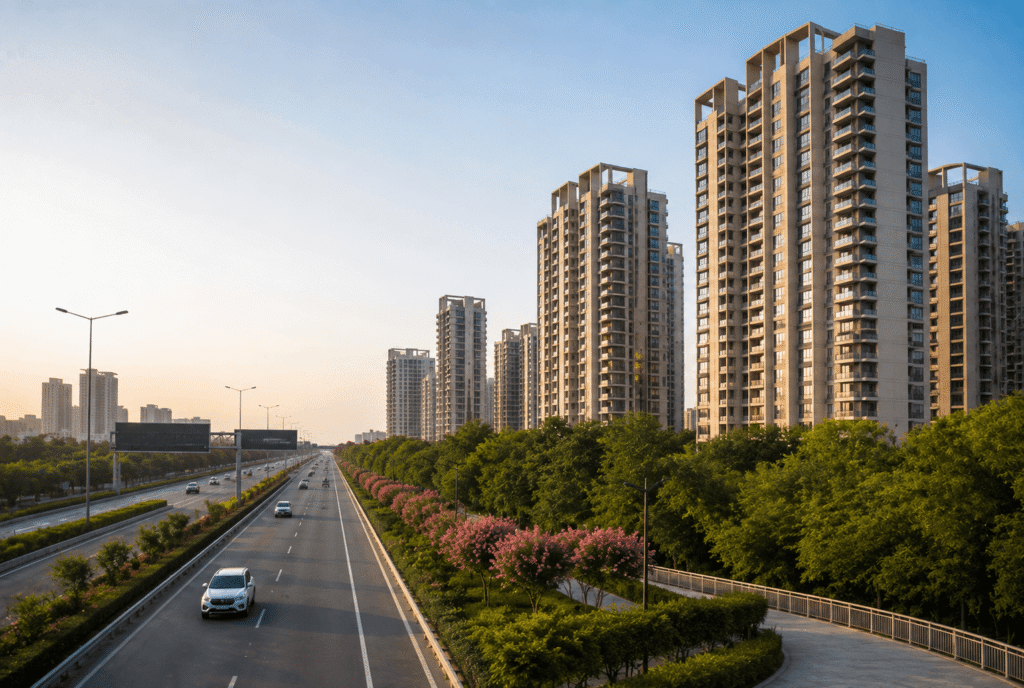
Quick Answer Dwarka Expressway is no longer just an upcoming realty corridor. The Haryana side has been running since March 2024, connectivity in Delhi has been gradually improved and the residential market around it now has occupied societies and resale stock, under construction projects and new luxury launches. The real question for buyers in 2026 is no longer whether Dwarka Expressway will become a reality, but which sector and project make sense at the price point you are considering. Most of the asking rates in the market and on portals are currently in the ₹11,000–₹18,000 per sq ft band, but the individual project rates may be materially off this mark depending on the type, and premium projects closer to the Delhi border area may shoot above ₹20,000 per sq ft in certain launches. Do not use these as transaction value guarantees. No Metro is available yet: there is a dedicated spur towards the corridor being built, and a new station will be located close to Sector 101, but no line is ready to be used now. Don’t always think of metro as an amenity; think of it as infrastructure for the future. The short version: Dwarka Expressway is worth serious consideration in 2026, but buying the corridor is not the same thing as buying the right property. Why Dwarka Expressway Property Deserves a Fresh Look in 2026 For years, the Dwarka Expressway saga has revolved around what was supposed to happen: the road was supposed to open, the airport connection was to be upgraded, metro connectivity was to be added, new sectors were to be built, large developers were to come in. Much of that expected future is now part of the present. The road has been opened, and people have moved into the residential areas; people are using the corridor daily, and new projects are being launched, and resale properties from existing projects are being offered. However, it doesn’t mean the corridor is complete, and it’s here that buyers should be careful. A successful expressway does not guarantee that all the service roads, drainage infrastructure, internal roadways, retail pockets, or social infrastructure in the immediate vicinity of a project are in place. The main carriageway and the surrounding neighbourhood can still be far apart, of course. This is why it’s not sufficient to have a brochure alone. The project can be publicized as “Dwarka Expressway” despite being located several minutes away from the road. A project can have an appealing launch price, but a significantly higher overall acquisition cost when parking charges, floor-rise, PLC, club charges, and other costs are taken into account. A “metro-connected” project could be a station that is not open today but will be opened in the future. The infrastructure story has developed; the due-diligence story hasn’t caught up. What is the Dwarka Expressway? The Dwarka Expressway, dubbed NH-248BB and Northern Peripheral Road (NPR), links the Dwarka area of Delhi with Gurugram and is an alternative route to the older, busier NH-48. The Haryana section is an 18-lane route about 19 km long, from the Delhi-Haryana border to Basai-Kherki Daula, and opened in March 2024. After that, the sections were opened one after the other on the Delhi side, such as the tunnelled section towards Dwarka and towards the airport. The overall corridor extends to approximately 29 km. The most important difference for buyers of real estate: The expressway is open, but the surrounding area is not. There is still some unevenness in supporting infrastructure facilities in some areas; service roads, drainage, and junction improvement facilities vary significantly between sectors, especially in Sectors 112–115, where service roads were still under construction and drainage work was still ongoing well into 2026. The difference is significant if one project is under the name of “Dwarka Expressway” and the other is in a completely different stage of readiness. Dwarka Expressway 2026: Key Facts at a Glance Factor 2026 position Official road designation NH-248BB Common name Dwarka Expressway / Northern Peripheral Road Approx. corridor length ~29 km Haryana carriageway Operational since March 2024 Delhi-side connectivity Progressively operational Airport connectivity Significantly improved Direct metro on the corridor Under construction — not operational as of September 2026 Core residential sectors 99, 99A, 102–104, 106, 108–109, 110A, 111–113 Indicative residential asking rates Roughly ₹11,000–₹18,000/sq ft across much of the market Premium developments Can exceed ₹20,000/sq ft in select launches Biggest buyer variable Project and developer quality Biggest due diligence issue Separating operational infrastructure from proposed infrastructure Prices, construction status, and infrastructure timelines are dynamic. The figures above are reference points based on information available around August–September 2026 and should be independently verified before you buy. Why Are Buyers Still Buying Property on Dwarka Expressway? The biggest change is simple: Dwarka Expressway is now being used, not merely discussed. Residents in sectors such as 102, 104, and 108 already use the corridor daily for travel toward Gurugram’s business districts, NH-48, Delhi, and other parts of the NCR, which puts the market on a different footing than the purely speculative phase this corridor went through in its earlier years. A few of the older residential projects are no longer sites of construction. Projects like Godrej Summit, Shapoorji Joyville and Hero Homes in Sector 104 are now established, occupied communities, where buyers can now draw their own inferences as to what a launch brochure cannot display – construction quality, maintenance standards, actual occupancy, traffic at the project gate, noise levels, parking, local retail, school-bus movement, internal roads, etc. and what the neighbourhood feels like after dark. Any clubhouse render is less telling than you’d get with a walk-along of an occupied society at 8 pm on a weekday. There’s also been an improvement in the airport and Delhi access. The Delhi side tunnelled link has reduced the travel time towards Dwarka and IGI Airport by a significant margin, especially for the projects closer to the Delhi end of the corridor, though caution should be taken in claiming the reduced travel time. That doesn’t mean
Best Areas to Buy Property Near Delhi Airport (2026)
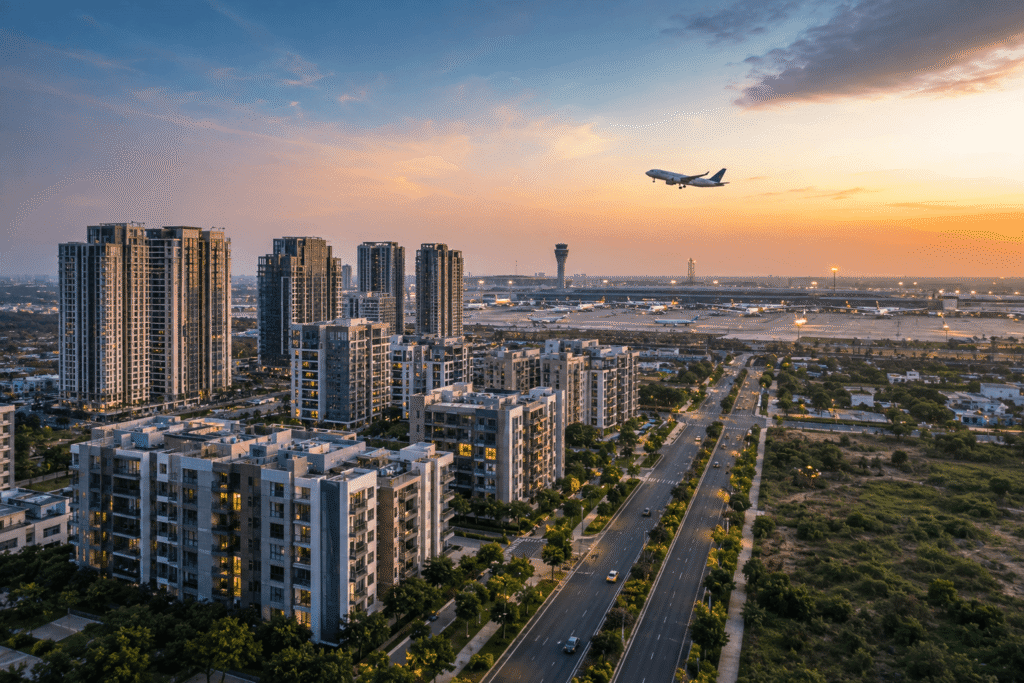
The IGI Airport has silently emerged as one of the biggest real estate buzzwords in Delhi NCR, and it is not because the airport location sounds glamorous, but because it caters to one very particular, high-end problem: commute time for the man who flies a lot. Corporate executives, NRIs who regularly do the back and forth, and entrepreneurs with a national or international reach all place a huge premium on property near Delhi Airport, and that demand has completely reshaped pricing across an entire corridor. This guide dissects which sectors and corridors are worth your consideration, with actual travel times, not wishy-washy “excellent connectivity” comments, so you can decide which location suits your budget and priorities. Quick Answer Buyers who want the quickest access to the airport are primarily considering sectors 113, 111, and 106 of Dwarka Expressway. The Delhi section of Dwarka Expressway now benefits from an airport tunnel and underpass system providing faster access to IGI Airport Terminal 3, with road journeys from the nearest Gurugram sectors often estimated at around 15-20 minutes in favourable traffic conditions. Golf Course Road currently benefits from a more developed luxury scene but has a longer commute, 30+ minutes along NH-48. The best choice depends on what you’re optimizing for, in terms of travel time, lifestyle, and potential long-term investment. Why Buy Property Near IGI Airport? Beyond the obvious convenience, proximity to a major international airport tends to support real estate value in a few specific, measurable ways: 1. Dwarka Expressway — The Corridor the Tunnel Changed Quick facts: Airport tunnel and underpass connectivity to IGI · commute ~15–20 min in favourable traffic conditions · 58% YoY price growth in Q4 2024 (CREDAI-Colliers-Liases Foras) · future appreciation will depend on market conditions, infrastructure completion and project quality No single corridor has benefited from airport proximity as directly as this one. The detail most guides skip: The Delhi section of Dwarka Expressway now benefits from an airport tunnel and underpass system providing faster access to IGI Airport Terminal 3. For the nearest Gurugram sectors, road journeys can be around 15–20 minutes in favourable traffic conditions, although actual travel times vary by sector, route and traffic. This isn’t a minor upgrade. It’s arguably the single biggest reason this corridor has outperformed most other NCR markets on price growth recently. A CREDAI-Colliers-Liases Foras report put Dwarka Expressway’s year-on-year price growth at 58% in Q4 2024, one of the strongest increases among the micro-markets tracked in Delhi NCR during that period. The corridor’s future appreciation will depend on infrastructure completion, supply, project quality, buyer demand, and broader market conditions. Why buyers prioritise it: 2. Sector 113 — The Closest Premium Address to the Airport Quick facts: ~15 min to IGI Airport · on Dwarka Expressway with direct tunnel access · highest price bracket on the corridor Sector 113 sits at the near end of the expressway, closest to the Delhi border and the airport tunnel itself, commonly cited as roughly 15 minutes from IGI Airport by road. It has among the shortest airport commutes of any Gurgaon residential sector, a concentration of ultra-premium high-rise developments, and particularly strong appeal among NRIs and C-suite executives given the commute advantage. That advantage comes at a cost: correspondingly, it carries the highest price bracket on the corridor. Best fit: Buyers for whom minimising airport travel time is the top priority, frequent flyers, and relocating executives. 3. Sector 111 — Comparable Access, More Room to Grow Quick facts: ~15–20 min to IGI Airport · similar access to Sector 113 · typically lower entry price Sector 111 sits just behind Sector 113 and offers very similar airport access and commute times in the same 15–20 minute range, while typically carrying a somewhat lower entry price, Sector 113’s status as the “closest” address commands its own premium that Sector 111 doesn’t have to pay. Advantages: near-comparable airport connectivity to Sector 113, more new residential launches (and therefore more configuration choices), improving physical infrastructure, and comparatively more room for appreciation since it isn’t already priced at the corridor’s ceiling. 4. Sector 106 — Balanced for Families and Investors Quick facts: ~20–25 min to IGI Airport · larger, more spacious layouts than the ultra-premium sectors · established developer presence Sector 106 sits a bit further along the corridor and has become popular with families rather than purely investment-focused buyers, largely because larger layouts are easier to find here than in the sectors closest to the tunnel. Reasons to consider it: Direct Dwarka Expressway access with a manageable commute, established developers running larger integrated communities, greener and lower-density surroundings relative to the corridor’s densest stretches, growing social infrastructure (schools, retail, healthcare), and strong resale demand as the surrounding ecosystem matures. Frequent travellers who also want more living space for the same budget often end up here rather than in Sectors 111 or 113. 5. Sector 102 — The More Affordable Entry Point Quick facts: ~25–30 min to IGI Airport · comparatively competitive pricing on the corridor · more headroom for appreciation Sector 102 sits further along the expressway and remains one of the more accessible entry points for buyers who want airport-adjacent connectivity without paying the premium the closest sectors command. Advantages: comparatively competitive pricing within the corridor, ongoing infrastructure development and newer launches, reasonable, if not the fastest, airport access, and more room for appreciation as this sector’s infrastructure catches up to its more developed neighbours. Best fit: buyers prioritising value and future upside over the shortest possible commute. 6. Golf Course Road — Established Luxury, Slightly Further Out Quick facts: 30+ min to IGI Airport via NH-48 · mature luxury ecosystem · strongest resale market on this list Golf Course Road isn’t part of the Dwarka Expressway corridor, but it remains one of Gurugram’s most prestigious addresses, with strong overall connectivity via NH-48 and the broader road network, just not airport-optimised the way the tunnel-linked sectors are. What sets it apart: A fully evolved luxury ecosystem (luxury retail, premium schools and hospitals, well-known corporate offices), strong
Dwarka Expressway Property Prices 2026: Sector-Wise Rates & Buyer Guide
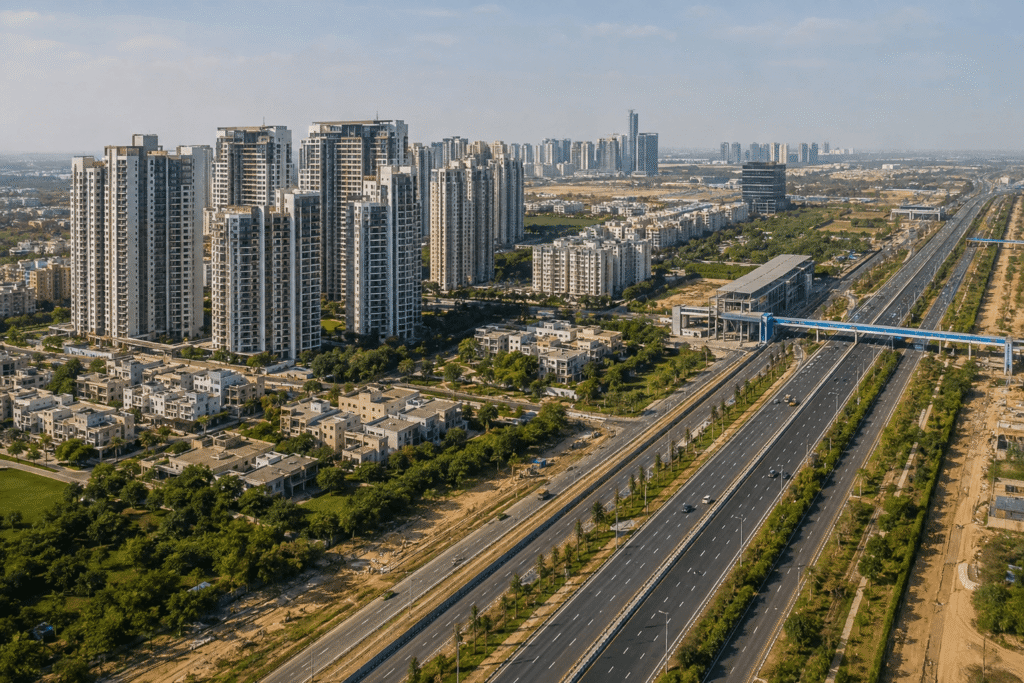
Dwarka Expressway property prices in 2026 vary significantly by sector, project, and property type. Based on locality-level pricing data reviewed in August 2026, the sectors covered in this article range from approximately ₹11,098 to ₹19,307 per sq ft. However, this is not a single corridor-wide market rate: new-launch pricing, resale rates, floor, configuration, project specifications and additional charges can materially change the final price. This guide provides sector-wise Dwarka Expressway property rates for 2026, explains why different sources report different numbers, and shows buyers how to calculate the actual acquisition cost before paying a token amount. What Is the Property Price on Dwarka Expressway in 2026? There is no single Dwarka Expressway property price in 2026. Locality-level benchmarks reviewed in August 2026 vary significantly by sector and property mix. Housing.com’s Dwarka Expressway locality data shows an overall average of approximately ₹12,688 per sq ft, while its sector-level figures range from about ₹11,098 per sq ft in Sector 37D to ₹19,307 per sq ft in Sector 36A. MagicBricks’ Q2 2026 data reports an average of approximately ₹14,661 per sq ft for multistorey apartments, with a locality range of approximately ₹11,024–₹18,298 per sq ft. Reviewed by the KMA Global Property Research Team | Last updated: August 10, 2026 Quick Answer: Dwarka Expressway property prices in 2026 vary widely by sector, project, and property type. Housing.com’s locality data reviewed in August 2026 ranges from approximately ₹11,098 per sq ft in Sector 37D to ₹19,307 per sq ft in Sector 36A. The overall locality average is approximately ₹12,688 per sq ft, while MagicBricks reports approximately ₹14,661 per sq ft for multistorey apartments in Q2 2026. These are locality/listing benchmarks rather than guaranteed transaction prices, and actual prices can vary based on project, floor, configuration, possession status, and additional charges. Dwarka Expressway Property Prices 2026: Sector-Wise Rates Sector Approx. 2026 Rate Sector 102 ₹13,831/sq ft Sector 103 ₹11,243/sq ft Sector 104 ₹14,563/sq ft Sector 106 ₹14,731/sq ft Sector 108 ₹13,439/sq ft Sector 109 ₹12,366/sq ft Sector 111 ₹15,560/sq ft Sector 112 ₹14,614/sq ft Sector 113 ₹16,969/sq ft Sector 36A ₹19,307/sq ft Sector 37D ₹11,098/sq ft Source: Housing.com locality data, reviewed August 2026. Why Property Prices Differ Across Dwarka Expressway Dwarka Expressway is not a single homogeneous residential market. Prices can vary considerably even between projects in the same sector. The main factors include developer reputation, project age, construction stage, apartment configuration, floor, view, specifications, amenities, possession timeline, and resale versus new-launch status. A ₹/sq-ft comparison is therefore meaningful only when the properties being compared have similar specifications, and the quoted rates include comparable charges. What Buyers Should Check Before Buying on Dwarka Expressway Before committing to any unit, four categories of checks are worth going through in order. Legal and regulatory checks Financial checks Property-level checks Carpet area vs. super built-up area, floor, facing, view, parking allotment, construction quality, current occupancy, amenities, and access roads all affect long-term value, not just the headline rate per square foot. Location checks — beyond the sector name A sector name on a map doesn’t tell you what daily life there looks like. It’s worth visiting the actual site at different times: A location that looks convenient on a map can feel very different once you’ve sat in the traffic it actually generates. How to Read Dwarka Expressway Property Prices A quoted price per sq ft does not always represent the final cost of a property. Buyers should first check whether the rate is calculated on carpet area, built-up area or super built-up/saleable area. New-launch prices may also exclude charges such as floor-rise, PLC, parking, club membership, maintenance deposits and other applicable costs. For an accurate comparison, compare properties using the same area basis and the same cost inclusions. Market Rate vs. Circle Rate: Two Different Numbers A common mix-up is treating the government circle (collector) rate as the market price. They’re not the same thing. Market rate is what buyers and sellers are actually negotiating and transacting at. Circle rate is a government-notified benchmark used for property registration and related stamp-duty calculations. It should not be treated as the same thing as the property’s market price. If the circle rate is ₹X, that doesn’t mean the property is worth ₹X, and a portal’s asking price isn’t automatically the final transaction value either. Always ask for both figures separately. How to Work Out the Approximate Price of a Flat Say a unit is quoted at ₹14,000 per sq ft on a saleable area of 1,800 sq ft: ₹14,000 × 1,800 = ₹2.52 crore That figure is only the starting point. The final acquisition cost typically also includes: Ask for a complete cost sheet before comparing two properties; the base rate alone can be misleading. What the 2026 Sector-Wise Data Shows What the 2026 Sector-Wise Data Shows: Housing.com’s current locality data reviewed for 2026 shows a wide price spread across Dwarka Expressway. Among the sectors covered in this article, the benchmark ranges from approximately ₹11,098 per sq ft in Sector 37D to ₹19,307 per sq ft in Sector 36A. Sector 113 is at approximately ₹16,969 per sq ft, while Sector 111 stands at approximately ₹15,560 per sq ft. MagicBricks’ Q2 2026 data reports an average of approximately ₹14,661 per sq ft for multistorey apartments in Dwarka Expressway, with a reported locality range of approximately ₹11,024–₹18,298 per sq ft. The difference between the two datasets is expected because the portals use different property samples and methodologies. Therefore, these figures should be treated as market/listing benchmarks rather than guaranteed transaction prices. What This Means for Buyers Dwarka Expressway’s residential market is no longer purely a future-infrastructure story. Improved connectivity and continued residential and commercial development have strengthened the corridor’s overall appeal. However, these factors alone do not determine whether a particular property is a good purchase. Buyers should evaluate the specific project, effective acquisition cost, developer track record, possession timeline, rental demand, resale liquidity, and future supply rather than relying only on the corridor-wide price per sq ft. How we interpret
Is Gurgaon Real Estate in a Bubble? Expert Market Analysis (2026)
Key Takeaways The Gurgaon property market in 2026 reflects a mix of strong fundamentals, higher valuations, and selective risks across micro-markets. Every time a Gurgaon micro-market posts a headline-grabbing price jump, the same question resurfaces on investor forums and WhatsApp groups: is this growth real, or is Gurgaon just the next market waiting to correct hard? A balanced answer requires looking beyond recent price growth and examining the fundamentals supporting demand, along with the risks that could affect future performance. This analysis examines what constitutes a real estate bubble and evaluates Gurgaon against those criteria, and crucially, does not ignore the more complex aspects of the story that lend themselves to a “this is normal” narrative. Whether you’re considering purchase, hold, or wait decisions, you need the uncomfortable data points just as much as the reassuring ones. Quick Answer Gurgaon does not currently show signs of a city-wide real estate bubble in 2026. Strong employment growth, infrastructure expansion, and end-user demand continue to support the market. However, some micro-markets have experienced unusually rapid appreciation, rental yields remain modest, and buyers should evaluate individual projects rather than the city as a whole. Metric Current Status Bubble Risk Low city-wide End-user Demand Strong Rental Yield Moderate (2–3%) Infrastructure Expanding Oversupply Limited Investment Horizon 5–10 years What Actually Defines a Real Estate Bubble? A property bubble forms when prices rise significantly beyond what underlying fundamentals such as income levels, rental returns, and genuine housing demand can justify. The usual warning signs include: Most historical property bubbles from the US in 2008 to parts of China more recently showed several of these at once. The relevant question for Gurgaon isn’t whether prices have risen fast (they have), but whether that rise is backed by real demand or mostly by speculation. Does Gurgaon Show Bubble Characteristics Today? Indicator Healthy Market Bubble Market Gurgaon (2026) End-user demand High Low High Rental demand Strong Weak Strong, but yields modest Infrastructure Expanding Weak/stagnant Expanding Speculative buying Moderate Very high Moderate, higher in select sectors Supply Balanced Oversupplied Broadly balanced Price volatility Low-moderate High, sharp reversals Moderate; one correction already seen in 2025 City-wide, Gurgaon lands closer to “healthy” than “bubble” on most indicators. But two rows in that table deserve more scrutiny than a simple checkmark, so these indicators require closer examination rather than a simple conclusion. Are Gurgaon Rental Yields Good in 2026? Residential rental yields in Gurgaon are generally estimated to range between 2% and 3% across many residential segments, according to industry research published by organizations such as Knight Frank, JLL, CBRE, and ANAROCK. While these yields are relatively modest compared to the city’s long-term capital appreciation potential, and lower than those typically seen in many commercial real estate assets, they do not, by themselves, indicate a property bubble. Investors focused on rental income should assess location-specific rental demand, vacancy rates, maintenance costs, and future growth prospects before making an investment decision. Low rental yield alone doesn’t prove a bubble; it’s normal in high-appreciation markets, where investors accept lower current income in exchange for capital growth. But it does mean Gurgaon residential property isn’t currently a strong pure income play, and any analysis that leans entirely on “rental demand is strong” without mentioning the yield number is giving you half the picture. If your primary goal is rental income rather than capital appreciation, rental yield should be one of the first metrics you evaluate, along with vacancy risk, maintenance costs, and future demand. Did Gurgaon Property Prices Correct Before 2026? The idea that Gurgaon property prices only move upward does not fully reflect recent market behaviour. After significant appreciation between 2021 and 2024, some residential segments experienced price moderation during 2025 as buyers became more selective and affordability pressures increased. The correction was not uniform across Gurgaon. Established premium locations, infrastructure-led corridors, and high-demand projects showed greater resilience, while some rapidly appreciated pockets saw more noticeable price adjustments. This moderation does not indicate a market collapse. Instead, it highlights that Gurgaon has entered a more mature phase where valuations are being tested against fundamentals such as employment growth, infrastructure delivery, supply discipline, and genuine end-user demand. A market capable of absorbing slower growth or limited corrections is different from one driven purely by speculative momentum. Why Have Gurgaon Property Prices Increased? The rise in prices over the past five years can be attributed to several real (rather than speculative) factors. Infrastructure Expansion The connectivity upgrade has significantly altered the commutable area of Gurgaon and consequently, also the demand for it, which is the fastest among all factors. Key developments include: Employment Growth Gurgaon remains one of India’s leading corporate hubs, with offices of multinational companies, technology firms, consulting firms, financial institutions, and Global Capability Centres. This results in a continuous, real demand for housing by professionals relocating for employment, as opposed to speculative buyers, who look to resell the home within months. Limited Premium Supply In general, developers have introduced premium inventory piecemeal, rather than introducing the market on a large scale, which has limited supply in key luxury corridors and allowed for a real, although limited, increase in prices. Rising Construction Costs Material inflation, labour costs, and higher construction and compliance standards have pushed up development costs industry-wide, which shows up directly in new-launch pricing. Some of today’s higher prices simply reflect what it costs to build now, not speculative markup. Which Gurgaon Areas Offer the Best Long-Term Investment Potential? Not every part of Gurgaon tells the same story, and lumping them together is where a lot of bubble commentary goes wrong. Corridors with strong appreciation backed by fundamentals: Gurgaon Real Estate Outlook by Corridor (2026) Corridor Market View Key Driver Dwarka Expressway Growth corridor Connectivity + new development SPR High-growth zone Commercial expansion Golf Course Extension Road Premium established market Luxury demand New Gurgaon Value growth corridor Affordability + infrastructure Golf Course Road Mature premium market Corporate demand Pockets worth more caution: Some Gurgaon micro-markets have significantly outperformed the city average due