Gurgaon Infrastructure Projects That Will Increase Property Prices (2026)
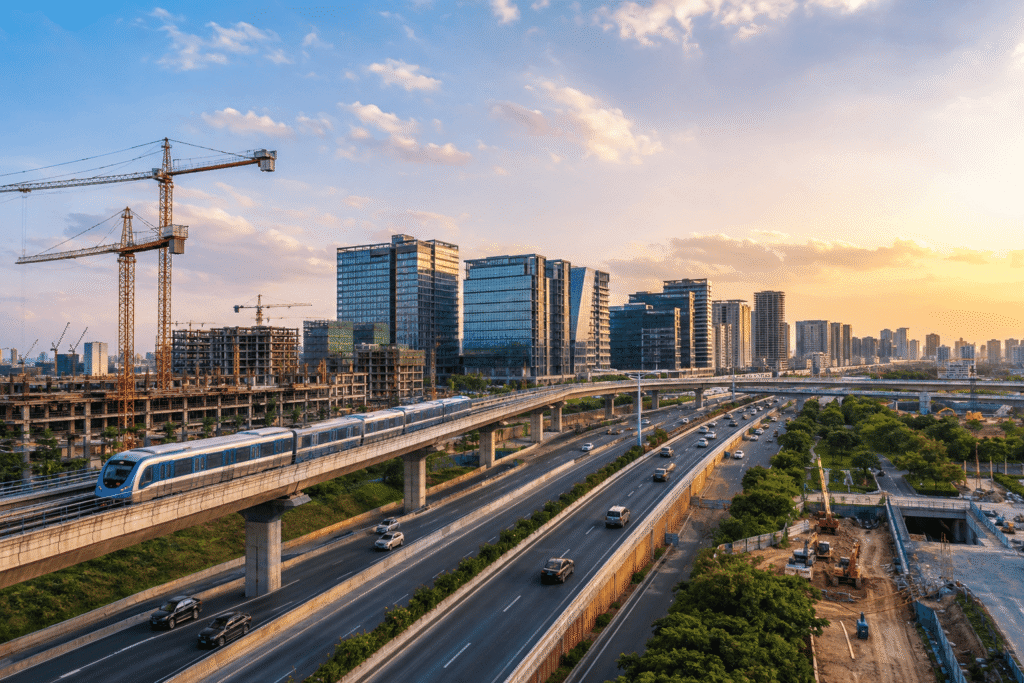
Gurgaon stopped being “a satellite of Delhi” a long time ago. It runs on a corporate base, a growing luxury housing segment, and a steady pipeline of public infrastructure spending, but infrastructure is also the part of the pitch that gets talked about the loosest. Every new road announcement gets called “game-changing” in a brochure, whether or not it actually is. This guide separates funded, under-construction work from proposals still waiting on approvals and looks at what each realistically means for property prices. Methodology note: This guide is based on publicly announced infrastructure projects, government agency updates, construction progress reports, and officially available project information. Timelines can shift as projects move forward. Quick Answer The Gurgaon infrastructure projects most likely to move property prices between now and 2027–2035 are the Gurgaon Metro expansion (28 km, 27 stations, targeted completion around 2027), Global City Gurgaon (a 1,000+ acre township with Phase 1 due December 2026 and full build-out by 2035), the already-operational Dwarka Expressway, and ongoing upgrades along SPR and Golf Course Extension Road. The projects that actually move prices are the ones with confirmed funding, visible construction, and realistic timelines, not the ones that simply read well in a press release. At a Glance: Active Infrastructure Projects Project Status Areas Likely to Benefit Time Horizon Dwarka Expressway Operational/ongoing Sectors 102–113, nearby areas Short–medium term Gurgaon Metro Under construction Sectors 45–48, 4, 5, 9, 10 Medium term Global City Phase 1 underway Sectors 36–37B Long term SPR Ongoing upgrades SPR corridor Medium term Golf Course Extension Road Ongoing improvements Adjacent sectors Medium term Why Infrastructure Actually Moves Property Prices Connectivity changes three things buyers and tenants care about directly: how long the commute is, how easily they can reach jobs and amenities, and how much daily friction is involved in simply living somewhere. When a road, metro line, or planned business district removes that friction, demand shows up, often before the project is even finished, because buyers and investors price in the expected improvement ahead of completion. The pattern generally plays out in this order: That last point is the timing lesson worth remembering: buyers who enter a corridor while infrastructure is still under construction, not after it’s finished and already priced in, tend to capture more of the upside. 1. Dwarka Expressway — Still the Biggest Growth Corridor Quick facts: 8-lane, largely elevated corridor · connects Delhi and Gurgaon directly to IGI Airport · anchors the Global City project · status: operational/ongoing This remains the single most-discussed infrastructure project in the region for a reason: it has materially cut travel time between the two cities and opened up sectors that were commercially unviable a decade ago. It provides direct access to IGI Airport via a previously congested route and continues to attract both residential launches and commercial development along its length. Investment impact: properties along already-completed stretches have captured most of their obvious appreciation. Sectors near the still-developing portions, particularly around the Global City site, likely have more room to run as the surrounding infrastructure catches up. 2. Gurgaon Metro Expansion — Funded, Under Construction, on a Real Timeline Quick facts: ~28 km corridor · 27 elevated stations · Millennium City Centre to Cyber City · Phase 1 (to ~Sector 9) active, piling/pillar work underway at Sector 45 and Subhash Chowk · Phase 2 (Sector 9 to Cyber City) went to tender early 2026 · targeted completion ~2027 Unlike infrastructure announcements that stay on paper for years, this one is genuinely under construction. Groundbreaking happened in late 2025/early 2026, and active work is visible in the field, not just on planning documents. The line also includes a dedicated 1.85 km spur connecting Basai Village directly to the Dwarka Expressway, plus interchange access with the existing Delhi Metro Yellow Line and Rapid Metro. Areas set to benefit most: Sectors 45, 46, 47, and 48, Hero Honda Chowk, Subhash Chowk, Palam Vihar, Udyog Vihar, and older, historically underserved sectors like 4, 5, 9, and 10. A second, separate corridor connecting Golf Course Extension Road, SPR, the Global City site, and onward to Manesar has also been proposed. It’s worth watching, but it’s still early in planning and tendering, not yet at the same construction stage as the Millennium City Centre–Cyber City line. Why this matters for pricing: metro-adjacent sectors across NCR have consistently shown stronger occupancy and appreciation once lines go operational, largely because reduced commute friction expands the realistic buyer pool for a location, not because of speculation. 3. Global City Gurgaon — The Largest Single Bet on Future Growth Quick facts: 1,000+ acre mixed-use township · developer: HSIIDC (Haryana State Industrial & Infrastructure Development Corporation) · Sectors 36, 36B, 37, 37B/D · total planned investment ~₹1 lakh crore · Phase 1 (587 acres, ₹940 crore) targeted for December 2026 · full completion targeted 2035 · ~20 minutes from IGI Airport, 20–30 minutes from Cyber City This is the most ambitious individual project on this list, sitting directly on the Dwarka Expressway. It’s planned to include Grade-A office space, residential towers, retail, hospitality, and public infrastructure, with an internal transit system planned for later phases. What this means for buyers: this is a genuine long-term catalyst, but the emphasis has to stay on the long term; the full build-out extends into the mid-2030s. Sectors immediately surrounding it are likely to see steady, staged demand growth as successive phases are completed, rather than one sudden price jump. 4. Southern Peripheral Road (SPR) Quick facts: Connects Golf Course Extension Road and NH-48, roughly parallel to the Delhi–Jaipur highway · status: ongoing upgrades SPR has moved from an underdeveloped stretch to one of Gurgaon’s more active mixed-use corridors over the past several years, with strong east-west connectivity linking two major growth zones, a growing mix of luxury residential, Grade-A office space, and retail, plus continued road upgrades supporting further expansion. It would also directly benefit from the proposed second metro line, if and when that advances past planning. What sets this corridor apart
Is Gurgaon Real Estate in a Bubble? Expert Market Analysis (2026)
Key Takeaways The Gurgaon property market in 2026 reflects a mix of strong fundamentals, higher valuations, and selective risks across micro-markets. Every time a Gurgaon micro-market posts a headline-grabbing price jump, the same question resurfaces on investor forums and WhatsApp groups: is this growth real, or is Gurgaon just the next market waiting to correct hard? A balanced answer requires looking beyond recent price growth and examining the fundamentals supporting demand, along with the risks that could affect future performance. This analysis examines what constitutes a real estate bubble and evaluates Gurgaon against those criteria, and crucially, does not ignore the more complex aspects of the story that lend themselves to a “this is normal” narrative. Whether you’re considering purchase, hold, or wait decisions, you need the uncomfortable data points just as much as the reassuring ones. Quick Answer Gurgaon does not currently show signs of a city-wide real estate bubble in 2026. Strong employment growth, infrastructure expansion, and end-user demand continue to support the market. However, some micro-markets have experienced unusually rapid appreciation, rental yields remain modest, and buyers should evaluate individual projects rather than the city as a whole. Metric Current Status Bubble Risk Low city-wide End-user Demand Strong Rental Yield Moderate (2–3%) Infrastructure Expanding Oversupply Limited Investment Horizon 5–10 years What Actually Defines a Real Estate Bubble? A property bubble forms when prices rise significantly beyond what underlying fundamentals such as income levels, rental returns, and genuine housing demand can justify. The usual warning signs include: Most historical property bubbles from the US in 2008 to parts of China more recently showed several of these at once. The relevant question for Gurgaon isn’t whether prices have risen fast (they have), but whether that rise is backed by real demand or mostly by speculation. Does Gurgaon Show Bubble Characteristics Today? Indicator Healthy Market Bubble Market Gurgaon (2026) End-user demand High Low High Rental demand Strong Weak Strong, but yields modest Infrastructure Expanding Weak/stagnant Expanding Speculative buying Moderate Very high Moderate, higher in select sectors Supply Balanced Oversupplied Broadly balanced Price volatility Low-moderate High, sharp reversals Moderate; one correction already seen in 2025 City-wide, Gurgaon lands closer to “healthy” than “bubble” on most indicators. But two rows in that table deserve more scrutiny than a simple checkmark, so these indicators require closer examination rather than a simple conclusion. Are Gurgaon Rental Yields Good in 2026? Residential rental yields in Gurgaon are generally estimated to range between 2% and 3% across many residential segments, according to industry research published by organizations such as Knight Frank, JLL, CBRE, and ANAROCK. While these yields are relatively modest compared to the city’s long-term capital appreciation potential, and lower than those typically seen in many commercial real estate assets, they do not, by themselves, indicate a property bubble. Investors focused on rental income should assess location-specific rental demand, vacancy rates, maintenance costs, and future growth prospects before making an investment decision. Low rental yield alone doesn’t prove a bubble; it’s normal in high-appreciation markets, where investors accept lower current income in exchange for capital growth. But it does mean Gurgaon residential property isn’t currently a strong pure income play, and any analysis that leans entirely on “rental demand is strong” without mentioning the yield number is giving you half the picture. If your primary goal is rental income rather than capital appreciation, rental yield should be one of the first metrics you evaluate, along with vacancy risk, maintenance costs, and future demand. Did Gurgaon Property Prices Correct Before 2026? The idea that Gurgaon property prices only move upward does not fully reflect recent market behaviour. After significant appreciation between 2021 and 2024, some residential segments experienced price moderation during 2025 as buyers became more selective and affordability pressures increased. The correction was not uniform across Gurgaon. Established premium locations, infrastructure-led corridors, and high-demand projects showed greater resilience, while some rapidly appreciated pockets saw more noticeable price adjustments. This moderation does not indicate a market collapse. Instead, it highlights that Gurgaon has entered a more mature phase where valuations are being tested against fundamentals such as employment growth, infrastructure delivery, supply discipline, and genuine end-user demand. A market capable of absorbing slower growth or limited corrections is different from one driven purely by speculative momentum. Why Have Gurgaon Property Prices Increased? The rise in prices over the past five years can be attributed to several real (rather than speculative) factors. Infrastructure Expansion The connectivity upgrade has significantly altered the commutable area of Gurgaon and consequently, also the demand for it, which is the fastest among all factors. Key developments include: Employment Growth Gurgaon remains one of India’s leading corporate hubs, with offices of multinational companies, technology firms, consulting firms, financial institutions, and Global Capability Centres. This results in a continuous, real demand for housing by professionals relocating for employment, as opposed to speculative buyers, who look to resell the home within months. Limited Premium Supply In general, developers have introduced premium inventory piecemeal, rather than introducing the market on a large scale, which has limited supply in key luxury corridors and allowed for a real, although limited, increase in prices. Rising Construction Costs Material inflation, labour costs, and higher construction and compliance standards have pushed up development costs industry-wide, which shows up directly in new-launch pricing. Some of today’s higher prices simply reflect what it costs to build now, not speculative markup. Which Gurgaon Areas Offer the Best Long-Term Investment Potential? Not every part of Gurgaon tells the same story, and lumping them together is where a lot of bubble commentary goes wrong. Corridors with strong appreciation backed by fundamentals: Gurgaon Real Estate Outlook by Corridor (2026) Corridor Market View Key Driver Dwarka Expressway Growth corridor Connectivity + new development SPR High-growth zone Commercial expansion Golf Course Extension Road Premium established market Luxury demand New Gurgaon Value growth corridor Affordability + infrastructure Golf Course Road Mature premium market Corporate demand Pockets worth more caution: Some Gurgaon micro-markets have significantly outperformed the city average due
Golf Course Road vs Golf Course Extension Road: Which Gurgaon Address Should You Choose?
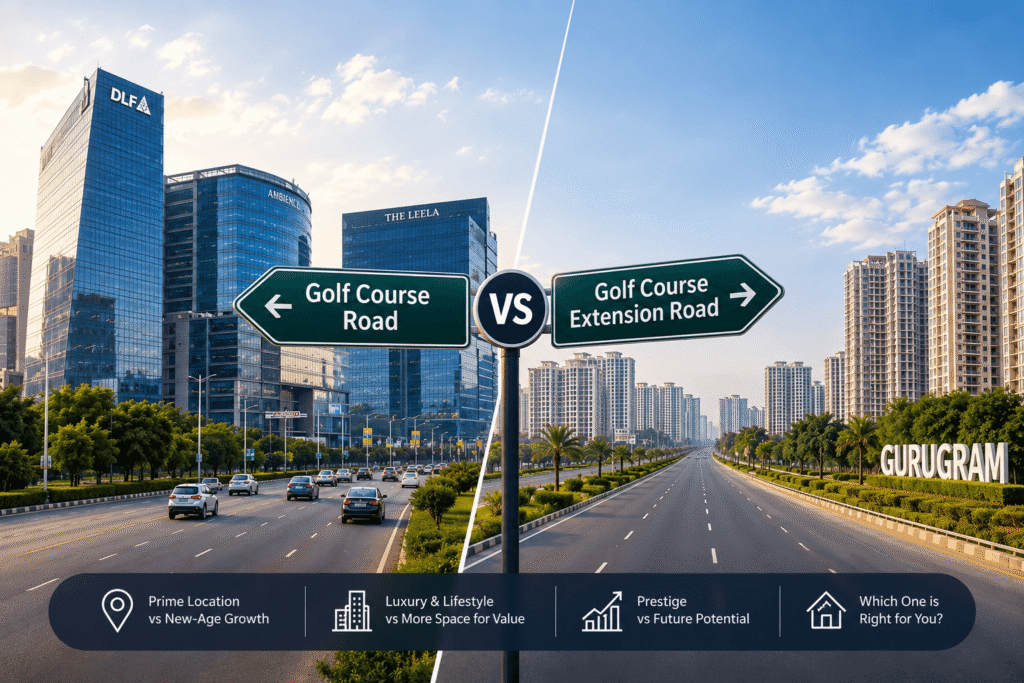
If you ask five realtors in Gurgaon to buy on Golf Course Road or Golf Course Extension Road, you’ll probably get five different answers, mainly because the two aisles aren’t really vying for the same taker. They are adjacent on a map, share a name, and are constantly compared, but they address different needs for different groups of people. This Vivaan guide lays out where every corridor actually sits today on price, connectedness, lifestyle and investment outlook, so you can match what the location offers to what you’re actually optimising for, instead of just deciding on which name sounds more premium. Golf Course Road and Golf Course Extension Road are the same? Originally developed as Gurgaon’s oldest luxury corridor, Golf Course Road was old, and much closer to Cyber City and MG Road, and the bubble that was already created amongst business, easy access, and commercial facilities. In fact, despite the file-shared name, Golf Course Extension Road evolved as a different corridor much southwards, and has been gaining up on infrastructure off late, while throwing up bigger units at far lesser entry prices. The primer: Maturity and prestige of address can be bought on Golf Course Road. Golf Course Extension Road boasts space and future upside. “Better” is not the point. Quick Answer Golf Course Road: A Name that Speaks of Luxury Why buyers choose Golf Course Road: The trade-off is cost. Because land availability here is limited and the location is already proven, property prices on Golf Course Road sit at a premium compared to almost every other Gurgaon corridor, including its own extension. Golf Extension Road: The Fast Budding Area Why buy at Golf Course Extension Road: As the corridor’s schools, hospitals, and retail continue to fill in, demand here is likely to keep strengthening, which is the core argument for buyers treating it as a long-term hold rather than a quick flip. Golf Course Road vs Golf Course Extension Road: Full Comparison Property Prices Golf Course Road commands a clear premium, driven by scarce land, an established reputation, and infrastructure that’s already fully built out. Buyers specifically wanting a ready-to-move luxury home in a proven location tend to accept this premium as the cost of certainty. Golf Course Extension Road, by contrast, offers materially more affordable entry points for comparable or larger unit sizes, while still delivering genuine connectivity to the broader luxury corridor. For buyers stretching to hit a budget without dropping out of the luxury segment entirely, this is usually where the math works better. Connectivity Both corridors are well connected, but to different things. Golf Course Road’s strength is its direct line to Cyber City, MG Road and Delhi via Rapid Metro, ideal if your daily commute runs toward those hubs. Golf Course Extension Road instead connects efficiently to Sohna Road, NH-48 and Southern Peripheral Road (SPR), linking residents to a different and rapidly growing set of commercial and employment clusters. Neither corridor is “less connected”; they’re oriented toward different parts of the city, so the right choice depends on where you actually need to get to on a normal workday. Lifestyle Golf Course Road provides a well-established urban lifestyle with luxury apartments, mature healthcare facilities, international schools, recreational facilities, etc., all in operation. Golf Course Extension Road is still carving the same ecosystem, but it’s progressing rapidly; quality schools, hospitals, supermarkets, gyms and cafes are popping up. For purchasers who were comfortable with a neighbourhood that was still being formed as opposed to fully formed, the trajectory here is a genuine positive rather than a compromise. Investment Potential Golf Course Extension Road is more attractive to investors willing to take a bit more risk in exchange for potentially higher return, as increasing infrastructure development and greater concentration of business activity tend to result in better appreciation over longer holding periods. Which Location Should You Choose? Choose Golf Course Road if you’re looking for: Choose Golf Course Extension Road If You Are Looking For: Factor Golf Course Road Golf Course Extension Road Positioning Established luxury corridor Emerging premium corridor Property Cost Higher premium pricing Better value entry Apartment Sizes Premium apartments Larger modern layouts Connectivity Cyber City, MG Road, Delhi SPR, Sohna Road, NH-48 Rental Demand Very strong Growing Appreciation Stable growth Higher future upside potential Best For Luxury lifestyle & rental income Families & long-term investors Common Mistakes Buyers Make When Comparing the Two FAQs Which is better for homebuyers, Golf Course Road or Golf Course Extension Road? Both offer real advantages for different buyers. Golf Course Road suits buyers who want an established luxury neighbourhood with minimal uncertainty. Golf Course Extension Road suits buyers looking for modern developments, larger homes and stronger long-term value. Is Golf Course Extension Road a good investment? Yes, for buyers comfortable with a longer horizon. Continuous infrastructure upgrades, expanding commercial development and rising residential demand make it a reasonable long-term investment corridor, though it carries more execution risk than the fully established Golf Course Road. Why are properties on Golf Course Road more expensive? Prices are higher because of limited land availability, an already-built-out infrastructure base, strong existing connectivity and sustained demand from buyers who want a proven location. These factors together support long-term price stability more than they drive dramatic appreciation. Which place is better for rental returns? Golf Course Road, on the other hand, has a better rental demand owing to the presence of well-established corporate houses. The rental market on Golf Course Extension Road is emerging as more professionals become attracted to the corridor, but it has yet to reach the depth of tenants found on Golf Course Road. Is Golf Course Extension Road good for family living? Yes. The two-lane road features gated communities, schools, hospitals, parks, and retail access, making it an ideal spot for families who value space and a more tranquil, nascent environment rather than one that is completely urban. Which location has better connectivity? Golf Course Road also has the closest access to Rapid Metro and Delhi-facing employment hubs. Golf Course Extension Road runs closer to Sohna Road, SPR and NH-48. Both