Gurgaon vs Noida: Which is Better for Property Investment in 2026?
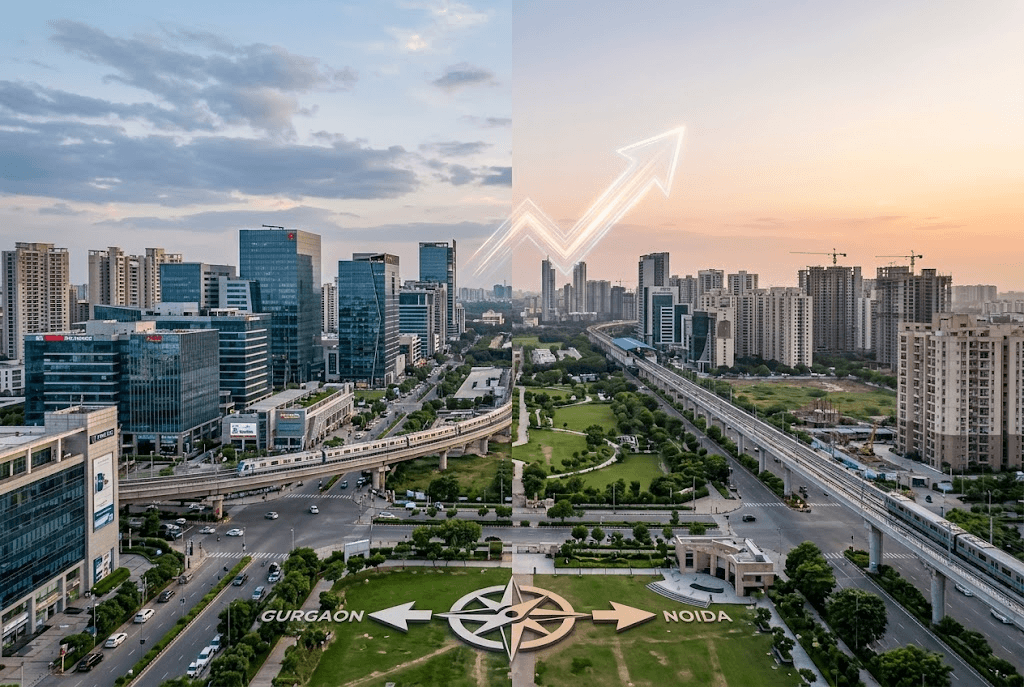
If you ask anyone who has been looking at estate in the National Capital Region for a while, they will almost always ask the same question: Gurgaon or Noida? Gurgaon has earned a name as the place for offices and high‑end homes in North India. Noida has made a name for planned infrastructure, lower prices, and a growing set of business zones. In 2026, Noida received a headline when the first phase of its international airport opened on March 28. Neither city is a winner. Which one suits you better depends on your budget, how you plan to hold the property, how much rent you want, and what you really want to achieve. In this guide, I compare Gurgaon and Noida by looking at prices, rental returns, roads, and transport, how much the property value grows, and how suitable each city is for investors. Below are the numbers for each city. Quick Answer I do not see a winner. The two cities serve different investment goals. Gurgaon apartment asking prices are around ₹14,850/sq ft based on the cited 2026 benchmark. Square Yards data from August 2026 says Noida’s ready‑to‑move homes average about ₹9,100 per foot, though prices change a lot by project and building stage. ANAROCK’s Q2 2026 data shows rental returns of about 4.3 % for Gurgaon and 3.9 % for Noida. Noida also has an infrastructure boost: the international airport at Jewar. Phase I opened on March 28, 2026. Commercial flights began on June 15, 2026. If you want income, a mature market, and premium homes, Gurgaon may suit you better. If you want an entry price and long‑term growth driven by new infrastructure, Noida may suit you better. Gurgaon Real Estate Market Gurgaon has become one of NCR’s most established real estate markets, supported by a large corporate base, strong demand for premium housing, and major infrastructure corridors. Global companies, startups, financial institutions, and professional services firms continue to create employment, which in turn supports demand for both homes and rental properties. Gurgaon has a strong base of large companies, global firms, startups, and financial institutions. These businesses create jobs and keep demand for homes strong, especially among working professionals and senior executives. This happens without depending on one building or project. Key growth corridors include Dwarka Expressway, Dwarka, Golf Course Road, Golf Course Extension Road, Southern Peripheral Road (SPR), New Gurgaon, and Sohna Road. The need for homes is mostly because of workers from companies, rich people looking for good houses, NRI buyers, and international professionals and businesses that rent space. This mix has helped keep the housing market strong property values going up and people selling homes easily. Noida Real Estate Market Noida has changed a lot from being a cheaper option than Gurgaon. Its planned areas, more jobs, and big construction projects have made it a separate place to invest within the NCR region. Major investment corridors: Noida Expressway, Greater Noida, Sector 150, Yamuna Expressway, the Jewar Airport region, Noida Extension. The main advantage is straightforward: buyers can still enter Noida at a lower price point while gaining exposure to a region where roads, transport links, commercial activity and employment hubs are expanding. The most important of these is the Jewar Airport. It brings a new airport and better transportation to the whole area. At a Glance Factor Gurgaon Noida Avg. asking price benchmark (2026) ~₹14,850/sq ft ~₹9,100/sq ft (ready-to-move) Illustrative premium locality benchmark ~₹21,350/sq ft (Golf Course Road) ~₹12,200/sq ft average (Sector 150 average) Rental yield benchmark (Q2 2026) ~4.3% gross ~3.9% gross Market maturity Established, mature Developing, infrastructure-led Key 2026 catalyst Corporate ecosystem + infrastructure Noida International Airport (Jewar) Typical investor focus Rental income, luxury, resale liquidity Affordability, long-term growth, first-time buyers Rental yields differ a lot depending on the micro‑market, the type of property, the size of the unit, and how much the property costs. I view these numbers as market benchmarks, not guarantees of returns. The figures are simply industry benchmarks, not set transaction prices. Always check the project‑level prices before making a decision. Infrastructure Comparison Infrastructure remains one of the drivers of property appreciation in both cities. However, the two markets are at different stages of their infrastructure cycle. Gurgaon already has a transportation network: Dwarka Expressway, NH‑48, the growing Delhi–Mumbai Expressway connectivity, Rapid Metro, SPR, CPR, and direct proximity to IGI Airport. This maturity is why the city attracts both end‑users and tenants who want infrastructure that is already delivered, not only promised. By contrast, Noida’s growth story is largely driven by infrastructure. Key developments are Noida International Airport, the Noida–Greater Noida Expressway, the Yamuna Expressway, the Aqua Metro Line, Film City and a growing set of logistics parks and industrial corridors. The airport stands out: Phase I was inaugurated on March 28, 2026. Commercial flight operations began on June 15, 2026. This is a concrete delivered milestone, not a proposal still waiting for approvals. Property Price Comparison The prices in Gurgaon stay high because the locations are premium, land supply is tight, corporate demand is steady, and many luxury projects are in the works. According to Square Yards March 2026 data, the average price in Gurgaon is ₹14,850 per square foot. The road called Golf Course Road has an average asking price of about ₹21,350 per square foot. Gurgaon requires a higher initial investment, but established micro-markets generally offer stronger resale liquidity. Noida offers a lower entry price, bigger apartments for the same amount of money, and more planned sectors. Square Yards August 2026 data shows ready‑to‑move projects cost about ₹9,100 per foot. Projects that are already occupied cost about ₹8,750 per foot. New‑launch projects cost a lot more, close to ₹14,850 per foot, showing that Noida has a wide price spread depending on the stage of the project. Premium areas such as Sector 150 cost ₹13,000 to ₹18,000 per square foot, still below Gurgaon’s highest prices. The main takeaway is simple: Noida remains more affordable than Gurgaon across many comparable segments. However, affordability is not uniform. New-launch projects in premium micro-markets can already be priced
Best Areas to Buy Property Near Delhi Airport (2026)
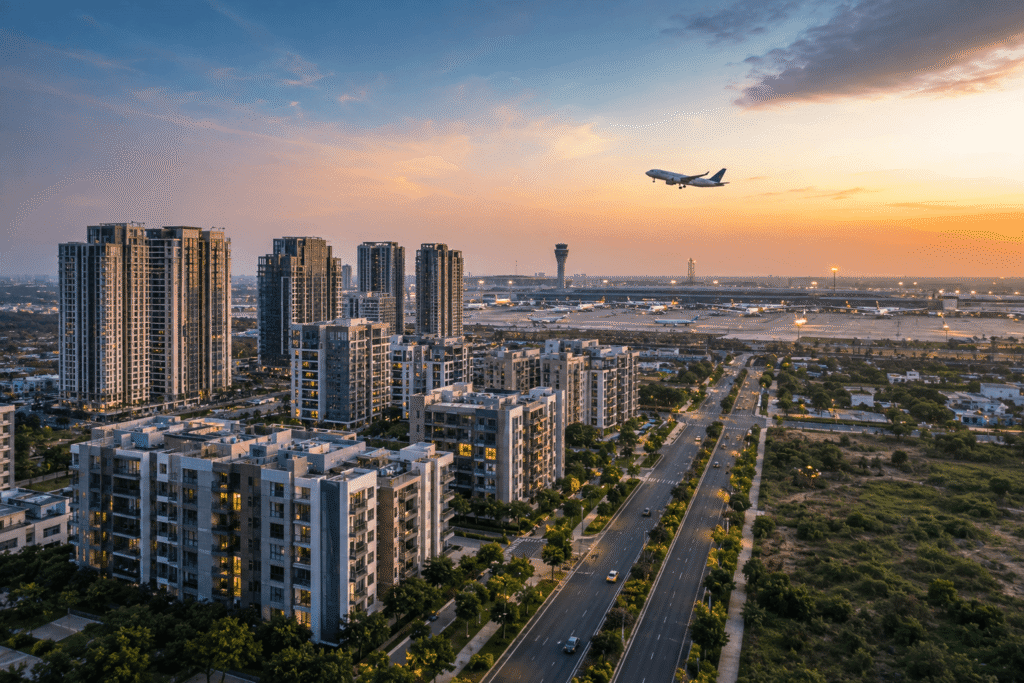
The IGI Airport has silently emerged as one of the biggest real estate buzzwords in Delhi NCR, and it is not because the airport location sounds glamorous, but because it caters to one very particular, high-end problem: commute time for the man who flies a lot. Corporate executives, NRIs who regularly do the back and forth, and entrepreneurs with a national or international reach all place a huge premium on property near Delhi Airport, and that demand has completely reshaped pricing across an entire corridor. This guide dissects which sectors and corridors are worth your consideration, with actual travel times, not wishy-washy “excellent connectivity” comments, so you can decide which location suits your budget and priorities. Quick Answer Buyers who want the quickest access to the airport are primarily considering sectors 113, 111, and 106 of Dwarka Expressway. The Delhi section of Dwarka Expressway now benefits from an airport tunnel and underpass system providing faster access to IGI Airport Terminal 3, with road journeys from the nearest Gurugram sectors often estimated at around 15-20 minutes in favourable traffic conditions. Golf Course Road currently benefits from a more developed luxury scene but has a longer commute, 30+ minutes along NH-48. The best choice depends on what you’re optimizing for, in terms of travel time, lifestyle, and potential long-term investment. Why Buy Property Near IGI Airport? Beyond the obvious convenience, proximity to a major international airport tends to support real estate value in a few specific, measurable ways: 1. Dwarka Expressway — The Corridor the Tunnel Changed Quick facts: Airport tunnel and underpass connectivity to IGI · commute ~15–20 min in favourable traffic conditions · 58% YoY price growth in Q4 2024 (CREDAI-Colliers-Liases Foras) · future appreciation will depend on market conditions, infrastructure completion and project quality No single corridor has benefited from airport proximity as directly as this one. The detail most guides skip: The Delhi section of Dwarka Expressway now benefits from an airport tunnel and underpass system providing faster access to IGI Airport Terminal 3. For the nearest Gurugram sectors, road journeys can be around 15–20 minutes in favourable traffic conditions, although actual travel times vary by sector, route and traffic. This isn’t a minor upgrade. It’s arguably the single biggest reason this corridor has outperformed most other NCR markets on price growth recently. A CREDAI-Colliers-Liases Foras report put Dwarka Expressway’s year-on-year price growth at 58% in Q4 2024, one of the strongest increases among the micro-markets tracked in Delhi NCR during that period. The corridor’s future appreciation will depend on infrastructure completion, supply, project quality, buyer demand, and broader market conditions. Why buyers prioritise it: 2. Sector 113 — The Closest Premium Address to the Airport Quick facts: ~15 min to IGI Airport · on Dwarka Expressway with direct tunnel access · highest price bracket on the corridor Sector 113 sits at the near end of the expressway, closest to the Delhi border and the airport tunnel itself, commonly cited as roughly 15 minutes from IGI Airport by road. It has among the shortest airport commutes of any Gurgaon residential sector, a concentration of ultra-premium high-rise developments, and particularly strong appeal among NRIs and C-suite executives given the commute advantage. That advantage comes at a cost: correspondingly, it carries the highest price bracket on the corridor. Best fit: Buyers for whom minimising airport travel time is the top priority, frequent flyers, and relocating executives. 3. Sector 111 — Comparable Access, More Room to Grow Quick facts: ~15–20 min to IGI Airport · similar access to Sector 113 · typically lower entry price Sector 111 sits just behind Sector 113 and offers very similar airport access and commute times in the same 15–20 minute range, while typically carrying a somewhat lower entry price, Sector 113’s status as the “closest” address commands its own premium that Sector 111 doesn’t have to pay. Advantages: near-comparable airport connectivity to Sector 113, more new residential launches (and therefore more configuration choices), improving physical infrastructure, and comparatively more room for appreciation since it isn’t already priced at the corridor’s ceiling. 4. Sector 106 — Balanced for Families and Investors Quick facts: ~20–25 min to IGI Airport · larger, more spacious layouts than the ultra-premium sectors · established developer presence Sector 106 sits a bit further along the corridor and has become popular with families rather than purely investment-focused buyers, largely because larger layouts are easier to find here than in the sectors closest to the tunnel. Reasons to consider it: Direct Dwarka Expressway access with a manageable commute, established developers running larger integrated communities, greener and lower-density surroundings relative to the corridor’s densest stretches, growing social infrastructure (schools, retail, healthcare), and strong resale demand as the surrounding ecosystem matures. Frequent travellers who also want more living space for the same budget often end up here rather than in Sectors 111 or 113. 5. Sector 102 — The More Affordable Entry Point Quick facts: ~25–30 min to IGI Airport · comparatively competitive pricing on the corridor · more headroom for appreciation Sector 102 sits further along the expressway and remains one of the more accessible entry points for buyers who want airport-adjacent connectivity without paying the premium the closest sectors command. Advantages: comparatively competitive pricing within the corridor, ongoing infrastructure development and newer launches, reasonable, if not the fastest, airport access, and more room for appreciation as this sector’s infrastructure catches up to its more developed neighbours. Best fit: buyers prioritising value and future upside over the shortest possible commute. 6. Golf Course Road — Established Luxury, Slightly Further Out Quick facts: 30+ min to IGI Airport via NH-48 · mature luxury ecosystem · strongest resale market on this list Golf Course Road isn’t part of the Dwarka Expressway corridor, but it remains one of Gurugram’s most prestigious addresses, with strong overall connectivity via NH-48 and the broader road network, just not airport-optimised the way the tunnel-linked sectors are. What sets it apart: A fully evolved luxury ecosystem (luxury retail, premium schools and hospitals, well-known corporate offices), strong
Gurgaon Infrastructure Projects That Will Increase Property Prices (2026)
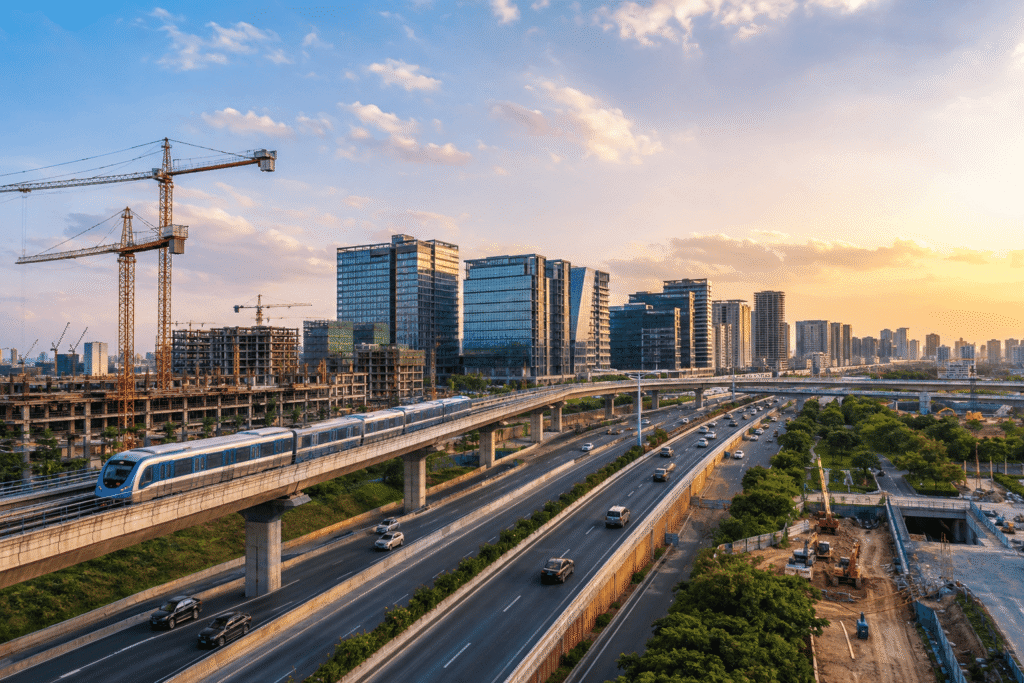
Gurgaon stopped being “a satellite of Delhi” a long time ago. It runs on a corporate base, a growing luxury housing segment, and a steady pipeline of public infrastructure spending, but infrastructure is also the part of the pitch that gets talked about the loosest. Every new road announcement gets called “game-changing” in a brochure, whether or not it actually is. This guide separates funded, under-construction work from proposals still waiting on approvals and looks at what each realistically means for property prices. Methodology note: This guide is based on publicly announced infrastructure projects, government agency updates, construction progress reports, and officially available project information. Timelines can shift as projects move forward. Quick Answer The Gurgaon infrastructure projects most likely to move property prices between now and 2027–2035 are the Gurgaon Metro expansion (28 km, 27 stations, targeted completion around 2027), Global City Gurgaon (a 1,000+ acre township with Phase 1 due December 2026 and full build-out by 2035), the already-operational Dwarka Expressway, and ongoing upgrades along SPR and Golf Course Extension Road. The projects that actually move prices are the ones with confirmed funding, visible construction, and realistic timelines, not the ones that simply read well in a press release. At a Glance: Active Infrastructure Projects Project Status Areas Likely to Benefit Time Horizon Dwarka Expressway Operational/ongoing Sectors 102–113, nearby areas Short–medium term Gurgaon Metro Under construction Sectors 45–48, 4, 5, 9, 10 Medium term Global City Phase 1 underway Sectors 36–37B Long term SPR Ongoing upgrades SPR corridor Medium term Golf Course Extension Road Ongoing improvements Adjacent sectors Medium term Why Infrastructure Actually Moves Property Prices Connectivity changes three things buyers and tenants care about directly: how long the commute is, how easily they can reach jobs and amenities, and how much daily friction is involved in simply living somewhere. When a road, metro line, or planned business district removes that friction, demand shows up, often before the project is even finished, because buyers and investors price in the expected improvement ahead of completion. The pattern generally plays out in this order: That last point is the timing lesson worth remembering: buyers who enter a corridor while infrastructure is still under construction, not after it’s finished and already priced in, tend to capture more of the upside. 1. Dwarka Expressway — Still the Biggest Growth Corridor Quick facts: 8-lane, largely elevated corridor · connects Delhi and Gurgaon directly to IGI Airport · anchors the Global City project · status: operational/ongoing This remains the single most-discussed infrastructure project in the region for a reason: it has materially cut travel time between the two cities and opened up sectors that were commercially unviable a decade ago. It provides direct access to IGI Airport via a previously congested route and continues to attract both residential launches and commercial development along its length. Investment impact: properties along already-completed stretches have captured most of their obvious appreciation. Sectors near the still-developing portions, particularly around the Global City site, likely have more room to run as the surrounding infrastructure catches up. 2. Gurgaon Metro Expansion — Funded, Under Construction, on a Real Timeline Quick facts: ~28 km corridor · 27 elevated stations · Millennium City Centre to Cyber City · Phase 1 (to ~Sector 9) active, piling/pillar work underway at Sector 45 and Subhash Chowk · Phase 2 (Sector 9 to Cyber City) went to tender early 2026 · targeted completion ~2027 Unlike infrastructure announcements that stay on paper for years, this one is genuinely under construction. Groundbreaking happened in late 2025/early 2026, and active work is visible in the field, not just on planning documents. The line also includes a dedicated 1.85 km spur connecting Basai Village directly to the Dwarka Expressway, plus interchange access with the existing Delhi Metro Yellow Line and Rapid Metro. Areas set to benefit most: Sectors 45, 46, 47, and 48, Hero Honda Chowk, Subhash Chowk, Palam Vihar, Udyog Vihar, and older, historically underserved sectors like 4, 5, 9, and 10. A second, separate corridor connecting Golf Course Extension Road, SPR, the Global City site, and onward to Manesar has also been proposed. It’s worth watching, but it’s still early in planning and tendering, not yet at the same construction stage as the Millennium City Centre–Cyber City line. Why this matters for pricing: metro-adjacent sectors across NCR have consistently shown stronger occupancy and appreciation once lines go operational, largely because reduced commute friction expands the realistic buyer pool for a location, not because of speculation. 3. Global City Gurgaon — The Largest Single Bet on Future Growth Quick facts: 1,000+ acre mixed-use township · developer: HSIIDC (Haryana State Industrial & Infrastructure Development Corporation) · Sectors 36, 36B, 37, 37B/D · total planned investment ~₹1 lakh crore · Phase 1 (587 acres, ₹940 crore) targeted for December 2026 · full completion targeted 2035 · ~20 minutes from IGI Airport, 20–30 minutes from Cyber City This is the most ambitious individual project on this list, sitting directly on the Dwarka Expressway. It’s planned to include Grade-A office space, residential towers, retail, hospitality, and public infrastructure, with an internal transit system planned for later phases. What this means for buyers: this is a genuine long-term catalyst, but the emphasis has to stay on the long term; the full build-out extends into the mid-2030s. Sectors immediately surrounding it are likely to see steady, staged demand growth as successive phases are completed, rather than one sudden price jump. 4. Southern Peripheral Road (SPR) Quick facts: Connects Golf Course Extension Road and NH-48, roughly parallel to the Delhi–Jaipur highway · status: ongoing upgrades SPR has moved from an underdeveloped stretch to one of Gurgaon’s more active mixed-use corridors over the past several years, with strong east-west connectivity linking two major growth zones, a growing mix of luxury residential, Grade-A office space, and retail, plus continued road upgrades supporting further expansion. It would also directly benefit from the proposed second metro line, if and when that advances past planning. What sets this corridor apart