Gurgaon vs Noida: Which is Better for Property Investment in 2026?
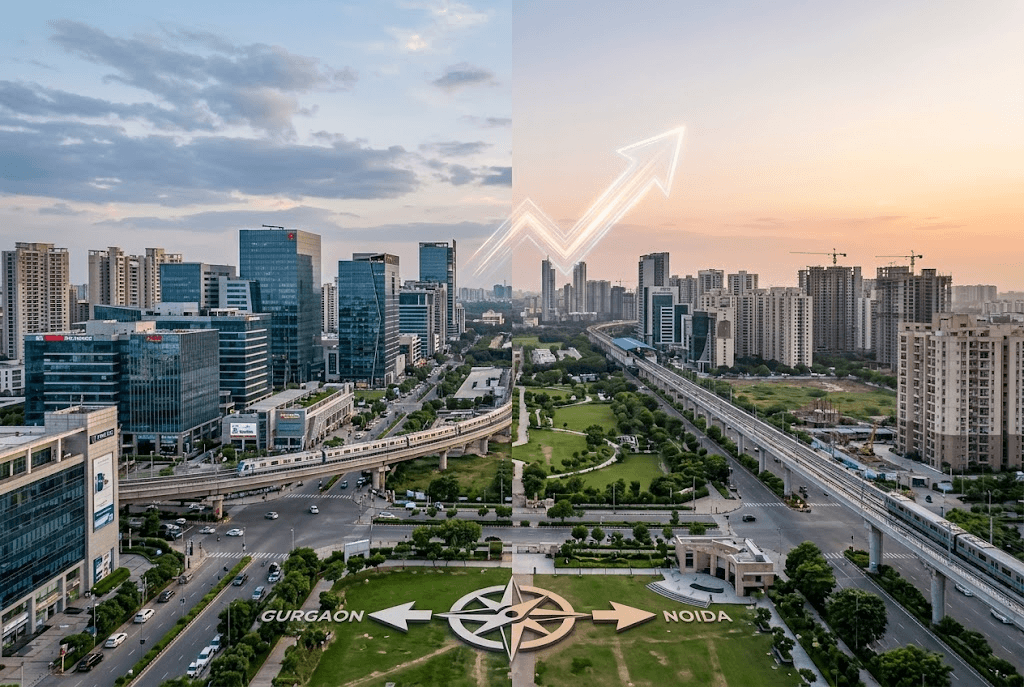
If you ask anyone who has been looking at estate in the National Capital Region for a while, they will almost always ask the same question: Gurgaon or Noida? Gurgaon has earned a name as the place for offices and high‑end homes in North India. Noida has made a name for planned infrastructure, lower prices, and a growing set of business zones. In 2026, Noida received a headline when the first phase of its international airport opened on March 28. Neither city is a winner. Which one suits you better depends on your budget, how you plan to hold the property, how much rent you want, and what you really want to achieve. In this guide, I compare Gurgaon and Noida by looking at prices, rental returns, roads, and transport, how much the property value grows, and how suitable each city is for investors. Below are the numbers for each city. Quick Answer I do not see a winner. The two cities serve different investment goals. Gurgaon apartment asking prices are around ₹14,850/sq ft based on the cited 2026 benchmark. Square Yards data from August 2026 says Noida’s ready‑to‑move homes average about ₹9,100 per foot, though prices change a lot by project and building stage. ANAROCK’s Q2 2026 data shows rental returns of about 4.3 % for Gurgaon and 3.9 % for Noida. Noida also has an infrastructure boost: the international airport at Jewar. Phase I opened on March 28, 2026. Commercial flights began on June 15, 2026. If you want income, a mature market, and premium homes, Gurgaon may suit you better. If you want an entry price and long‑term growth driven by new infrastructure, Noida may suit you better. Gurgaon Real Estate Market Gurgaon has become one of NCR’s most established real estate markets, supported by a large corporate base, strong demand for premium housing, and major infrastructure corridors. Global companies, startups, financial institutions, and professional services firms continue to create employment, which in turn supports demand for both homes and rental properties. Gurgaon has a strong base of large companies, global firms, startups, and financial institutions. These businesses create jobs and keep demand for homes strong, especially among working professionals and senior executives. This happens without depending on one building or project. Key growth corridors include Dwarka Expressway, Dwarka, Golf Course Road, Golf Course Extension Road, Southern Peripheral Road (SPR), New Gurgaon, and Sohna Road. The need for homes is mostly because of workers from companies, rich people looking for good houses, NRI buyers, and international professionals and businesses that rent space. This mix has helped keep the housing market strong property values going up and people selling homes easily. Noida Real Estate Market Noida has changed a lot from being a cheaper option than Gurgaon. Its planned areas, more jobs, and big construction projects have made it a separate place to invest within the NCR region. Major investment corridors: Noida Expressway, Greater Noida, Sector 150, Yamuna Expressway, the Jewar Airport region, Noida Extension. The main advantage is straightforward: buyers can still enter Noida at a lower price point while gaining exposure to a region where roads, transport links, commercial activity and employment hubs are expanding. The most important of these is the Jewar Airport. It brings a new airport and better transportation to the whole area. At a Glance Factor Gurgaon Noida Avg. asking price benchmark (2026) ~₹14,850/sq ft ~₹9,100/sq ft (ready-to-move) Illustrative premium locality benchmark ~₹21,350/sq ft (Golf Course Road) ~₹12,200/sq ft average (Sector 150 average) Rental yield benchmark (Q2 2026) ~4.3% gross ~3.9% gross Market maturity Established, mature Developing, infrastructure-led Key 2026 catalyst Corporate ecosystem + infrastructure Noida International Airport (Jewar) Typical investor focus Rental income, luxury, resale liquidity Affordability, long-term growth, first-time buyers Rental yields differ a lot depending on the micro‑market, the type of property, the size of the unit, and how much the property costs. I view these numbers as market benchmarks, not guarantees of returns. The figures are simply industry benchmarks, not set transaction prices. Always check the project‑level prices before making a decision. Infrastructure Comparison Infrastructure remains one of the drivers of property appreciation in both cities. However, the two markets are at different stages of their infrastructure cycle. Gurgaon already has a transportation network: Dwarka Expressway, NH‑48, the growing Delhi–Mumbai Expressway connectivity, Rapid Metro, SPR, CPR, and direct proximity to IGI Airport. This maturity is why the city attracts both end‑users and tenants who want infrastructure that is already delivered, not only promised. By contrast, Noida’s growth story is largely driven by infrastructure. Key developments are Noida International Airport, the Noida–Greater Noida Expressway, the Yamuna Expressway, the Aqua Metro Line, Film City and a growing set of logistics parks and industrial corridors. The airport stands out: Phase I was inaugurated on March 28, 2026. Commercial flight operations began on June 15, 2026. This is a concrete delivered milestone, not a proposal still waiting for approvals. Property Price Comparison The prices in Gurgaon stay high because the locations are premium, land supply is tight, corporate demand is steady, and many luxury projects are in the works. According to Square Yards March 2026 data, the average price in Gurgaon is ₹14,850 per square foot. The road called Golf Course Road has an average asking price of about ₹21,350 per square foot. Gurgaon requires a higher initial investment, but established micro-markets generally offer stronger resale liquidity. Noida offers a lower entry price, bigger apartments for the same amount of money, and more planned sectors. Square Yards August 2026 data shows ready‑to‑move projects cost about ₹9,100 per foot. Projects that are already occupied cost about ₹8,750 per foot. New‑launch projects cost a lot more, close to ₹14,850 per foot, showing that Noida has a wide price spread depending on the stage of the project. Premium areas such as Sector 150 cost ₹13,000 to ₹18,000 per square foot, still below Gurgaon’s highest prices. The main takeaway is simple: Noida remains more affordable than Gurgaon across many comparable segments. However, affordability is not uniform. New-launch projects in premium micro-markets can already be priced
Gurgaon Infrastructure Projects That Will Increase Property Prices (2026)
Gurgaon stopped being “a satellite of Delhi” a long time ago. It runs on a corporate base, a growing luxury housing segment, and a steady pipeline of public infrastructure spending, but infrastructure is also the part of the pitch that gets talked about the loosest. Every new road announcement gets called “game-changing” in a brochure, whether or not it actually is. This guide separates funded, under-construction work from proposals still waiting on approvals and looks at what each realistically means for property prices. Methodology note: This guide is based on publicly announced infrastructure projects, government agency updates, construction progress reports, and officially available project information. Timelines can shift as projects move forward. Quick Answer The Gurgaon infrastructure projects most likely to move property prices between now and 2027–2035 are the Gurgaon Metro expansion (28 km, 27 stations, targeted completion around 2027), Global City Gurgaon (a 1,000+ acre township with Phase 1 due December 2026 and full build-out by 2035), the already-operational Dwarka Expressway, and ongoing upgrades along SPR and Golf Course Extension Road. The projects that actually move prices are the ones with confirmed funding, visible construction, and realistic timelines, not the ones that simply read well in a press release. At a Glance: Active Infrastructure Projects Project Status Areas Likely to Benefit Time Horizon Dwarka Expressway Operational/ongoing Sectors 102–113, nearby areas Short–medium term Gurgaon Metro Under construction Sectors 45–48, 4, 5, 9, 10 Medium term Global City Phase 1 underway Sectors 36–37B Long term SPR Ongoing upgrades SPR corridor Medium term Golf Course Extension Road Ongoing improvements Adjacent sectors Medium term Why Infrastructure Actually Moves Property Prices Connectivity changes three things buyers and tenants care about directly: how long the commute is, how easily they can reach jobs and amenities, and how much daily friction is involved in simply living somewhere. When a road, metro line, or planned business district removes that friction, demand shows up, often before the project is even finished, because buyers and investors price in the expected improvement ahead of completion. The pattern generally plays out in this order: That last point is the timing lesson worth remembering: buyers who enter a corridor while infrastructure is still under construction, not after it’s finished and already priced in, tend to capture more of the upside. 1. Dwarka Expressway — Still the Biggest Growth Corridor Quick facts: 8-lane, largely elevated corridor · connects Delhi and Gurgaon directly to IGI Airport · anchors the Global City project · status: operational/ongoing This remains the single most-discussed infrastructure project in the region for a reason: it has materially cut travel time between the two cities and opened up sectors that were commercially unviable a decade ago. It provides direct access to IGI Airport via a previously congested route and continues to attract both residential launches and commercial development along its length. Investment impact: properties along already-completed stretches have captured most of their obvious appreciation. Sectors near the still-developing portions, particularly around the Global City site, likely have more room to run as the surrounding infrastructure catches up. 2. Gurgaon Metro Expansion — Funded, Under Construction, on a Real Timeline Quick facts: ~28 km corridor · 27 elevated stations · Millennium City Centre to Cyber City · Phase 1 (to ~Sector 9) active, piling/pillar work underway at Sector 45 and Subhash Chowk · Phase 2 (Sector 9 to Cyber City) went to tender early 2026 · targeted completion ~2027 Unlike infrastructure announcements that stay on paper for years, this one is genuinely under construction. Groundbreaking happened in late 2025/early 2026, and active work is visible in the field, not just on planning documents. The line also includes a dedicated 1.85 km spur connecting Basai Village directly to the Dwarka Expressway, plus interchange access with the existing Delhi Metro Yellow Line and Rapid Metro. Areas set to benefit most: Sectors 45, 46, 47, and 48, Hero Honda Chowk, Subhash Chowk, Palam Vihar, Udyog Vihar, and older, historically underserved sectors like 4, 5, 9, and 10. A second, separate corridor connecting Golf Course Extension Road, SPR, the Global City site, and onward to Manesar has also been proposed. It’s worth watching, but it’s still early in planning and tendering, not yet at the same construction stage as the Millennium City Centre–Cyber City line. Why this matters for pricing: metro-adjacent sectors across NCR have consistently shown stronger occupancy and appreciation once lines go operational, largely because reduced commute friction expands the realistic buyer pool for a location, not because of speculation. 3. Global City Gurgaon — The Largest Single Bet on Future Growth Quick facts: 1,000+ acre mixed-use township · developer: HSIIDC (Haryana State Industrial & Infrastructure Development Corporation) · Sectors 36, 36B, 37, 37B/D · total planned investment ~₹1 lakh crore · Phase 1 (587 acres, ₹940 crore) targeted for December 2026 · full completion targeted 2035 · ~20 minutes from IGI Airport, 20–30 minutes from Cyber City This is the most ambitious individual project on this list, sitting directly on the Dwarka Expressway. It’s planned to include Grade-A office space, residential towers, retail, hospitality, and public infrastructure, with an internal transit system planned for later phases. What this means for buyers: this is a genuine long-term catalyst, but the emphasis has to stay on the long term; the full build-out extends into the mid-2030s. Sectors immediately surrounding it are likely to see steady, staged demand growth as successive phases are completed, rather than one sudden price jump. 4. Southern Peripheral Road (SPR) Quick facts: Connects Golf Course Extension Road and NH-48, roughly parallel to the Delhi–Jaipur highway · status: ongoing upgrades SPR has moved from an underdeveloped stretch to one of Gurgaon’s more active mixed-use corridors over the past several years, with strong east-west connectivity linking two major growth zones, a growing mix of luxury residential, Grade-A office space, and retail, plus continued road upgrades supporting further expansion. It would also directly benefit from the proposed second metro line, if and when that advances past planning. What sets this corridor apart
Dwarka Expressway vs SPR vs New Gurgaon: Best Investment in 2026
Three corridors, three completely different investment stories. Dwarka Expressway, Southern Peripheral Road (SPR), and New Gurgaon all get lumped together as “Gurugram real estate,” but they don’t compete for the same buyer. The right question isn’t which one is best overall; it’s which one matches your budget, horizon, and reason for buying. Quick Answer There’s no single winner among these three corridors; it comes down to what you’re optimizing for. Dwarka Expressway suits investors chasing long-term capital appreciation and Delhi/airport connectivity, with Housing.com pricing it at roughly ₹12,688/sq ft. SPR fits buyers who want established demand and stronger rental depth, priced higher at roughly ₹16,919/sq ft. New Gurgaon offers the lowest entry point of the three, around ₹11,582/sq ft, with reported year-on-year growth of about 14.1%, good for buyers prioritizing affordability and a longer runway. These are Housing.com locality benchmarks; MagicBricks’ Q2 2026 data runs somewhat higher for Dwarka Expressway (~₹14,661/sq ft) and SPR (~₹18,027/sq ft), so treat all figures as indicative, not fixed. At a Glance Factor Dwarka Expressway SPR New Gurgaon Current price positioning Mid to premium Premium Lower to mid Market maturity Developing/maturing More established Developing Capital appreciation potential High, but project-specific Moderate to high High, but location-specific Rental demand Growing Stronger in established pockets Moderate to growing Entry affordability Moderate Lower affordability Relatively better Airport/Delhi connectivity Strong Moderate Moderate Resale liquidity Improving Relatively stronger Varies by project Best suited for Growth-focused investors Balanced investors/end-users Early-growth investors Key risk Paying a premium for future potential Higher entry price Micro-market and supply selection This is a qualitative investment framework, not a forecast of returns. Current Prices Across the Three Corridors (2026) Price comparisons only mean something with context attached, so here’s each corridor on its own terms before we put them side by side. Dwarka Expressway: Housing.com’s 2026 locality data for Dwarka Expressway shows an average of about ₹12,688/sq ft, with sector-specific rates varying between approximately ₹11,098/sq ft in Sector 37D to ₹19,307/sq ft in Sector 36A (Sector 102: ~₹13,831; Sector 104: ~₹14,563; Sector 106: ~₹14,731; Sector 113: ~₹16,969). MagicBricks Q2 2026 4BHK price on property per sq ft prices in locality is as low as approx. ₹11,024 and as high as ₹18,298/sq ft. Southern Peripheral Road (SPR): Housing.com 2026 The average is around ₹16,919 per square foot with a min-max range of ₹9,615 to ₹28,888 per sq ft. MagicBricks’ Q2 2026 data reveals that high-rises in particular earn about ₹18,027/sq ft, with the locality range ranging up to approximately ₹22,336/sq ft. That premium is all about a more mature residential ecosystem and access to existing jobs and lifestyle hubs. New Gurgaon: Housing.com’s current data puts the average at approximately ₹11,582/sq ft, with reported year-on-year growth of around 14.1%. Worth flagging: “New Gurgaon” is a broad label, and pricing between sectors and projects varies a lot — a Sector 81–85 project isn’t directly comparable to one closer to Manesar. The pattern: New Gurgaon has the lowest average entry point of the three; this corridor sits in the middle, and SPR commands the highest average pricing. A lower price, though, doesn’t automatically translate into higher future returns. Why Dwarka Expressway Is a Different Kind of Bet This corridor’s investment story is built almost entirely on infrastructure and connectivity. It links Gurugram to Delhi, provides access to NH-48, and sits close to IGI Airport and the wider Delhi-NCR network. It’s also matured past being a purely speculative “future corridor,” with real residential and commercial development now on the ground. That maturity comes with a caveat: not every project here will appreciate at the same rate. A ₹12,000/sq ft project and an ₹18,000/sq ft project can sit on the same stretch of road while differing completely in developer profile, construction stage, apartment size, density, rental demand, resale liquidity, competing future supply, and effective acquisition cost. This corridor may suit you if you: The mistake buyers make here is treating the whole road as one investment. The project matters more than the road name. Why SPR Commands a Premium SPR’s edge isn’t future potential; it’s present-day maturity. Several pockets already sit inside an established residential and commercial ecosystem around Golf Course Extension Road, Sohna Road, and other major employment corridors, and current pricing (~₹16,919/sq ft on Housing.com, ~₹18,027/sq ft on MagicBricks for multi-storey apartments) reflects that. The trade-off is straightforward: you pay more upfront, in exchange for established neighbourhoods, existing occupancy, proximity to employment hubs, stronger rental depth in select pockets, more developed social infrastructure, and deeper end-user demand. The catch: because prices already start higher, entry discipline matters even more here. A good project bought at a fair valuation is a very different investment than an expensive unit bought purely on the strength of the corridor’s brand name. SPR may suit you if you: Why New Gurgaon Deserves More Attention Than It Gets This micro-market tends to get overlooked simply because it lacks the premium branding of the other two; that’s arguably a mistake. Housing.com’s current data shows an average of approximately ₹11,582/sq ft with roughly 14.1% year-on-year growth, and the appeal is the combination of relative affordability with a large residential catchment, plus connectivity toward NH-48, Manesar, and other employment areas. The label is broader than the other two, though differences between sectors, projects, and developers here can be substantial, so “New Gurgaon” alone isn’t specific enough to base a decision on. This micro-market may suit you if you: For end-users specifically, it also offers a broader spread of configurations and price points to choose from. Which Has Better Connectivity? Each corridor’s connectivity strength points in a different direction: There’s no single winner; the “best” connectivity depends entirely on where you actually need to go. Which Has Better Rental Potential? Rental yield and capital appreciation are two separate questions; a property can appreciate well while producing modest rent, or generate solid rent without delivering standout appreciation. SPR currently has an edge in select pockets thanks to established occupancy and proximity to employment centres. This expressway’s rental market is still developing as more
Is Dwarka Expressway Overpriced in 2026? A Data-Driven Buyer Guide
Property prices on this corridor are undeniably higher than their historical levels, but “overpriced” is a verdict that needs a project name attached to it, not a blanket label for the whole stretch. Rates swing by more than ₹8,000 per sq ft between sectors, so the real question isn’t whether the corridor is expensive. It’s whether the specific property you’re looking at earns its price. Quick Answer This corridor as a whole is not uniformly overpriced, though individual projects can be. Housing.com’s 2026 locality data puts the average price at roughly ₹12,688 per sq ft, with sector averages ranging from about ₹11,098/sq ft in Sector 37D to ₹19,307/sq ft in Sector 36A, and a reported 3.52% year-on-year rise. MagicBricks’ Q2 2026 data shows a higher multi-storey apartment benchmark of roughly ₹14,661/sq ft, but a quarter-on-quarter dip of about -1%, suggesting the market isn’t rising evenly across the corridor. The honest answer: it depends entirely on which sector and which project you’re comparing. Why “Is Dwarka Expressway Overpriced?” Is the Wrong Question This corridor isn’t one market; it’s a collection of very different micro-markets sharing one address. A resale apartment at ₹11,000/sq ft and a branded luxury tower at ₹19,000/sq ft can both sit on the same road, and neither price tells you much about the other. That’s why the more useful question isn’t “Is Dwarka Expressway expensive?“ It’s: at this price, am I getting enough location, connectivity, rental demand, project quality, and future growth to justify what I’m paying? Dwarka Expressway Property Prices by Sector (2026) Sector Approx. 2026 Average Rate 37D ₹11,098/sq ft 103 ₹11,243/sq ft 109 ₹12,366/sq ft 108 ₹13,439/sq ft 102 ₹13,831/sq ft 104 ₹14,563/sq ft 112 ₹14,614/sq ft 106 ₹14,731/sq ft 111 ₹15,560/sq ft 113 ₹16,969/sq ft 36A ₹19,307/sq ft Source: Housing.com locality-level data, reviewed July/August 2026. That’s a spread of more than ₹8,000 per sq ft from the cheapest to the priciest sector, roughly a 74% gap. A ₹2 crore resale buyer and a ₹6 crore luxury buyer are effectively shopping in two different markets that happen to share a highway. Why Do People Call Dwarka Expressway Overpriced? 1. Prices have climbed sharply from where they started The corridor was formerly marketed almost entirely on future promise, on infrastructure that had not yet arrived. That promise has been mostly fulfilled: NHAI confirms that the 19km, eight-lane Haryana stretch was thrown open in March 2024, from the Delhi-Haryana border (Basai railway overbridge) to Kherki Daula, with further access to IGI Airport and the Gurugram bypass. As the infrastructure materialized, prices moved with it. The catch for today’s buyer is straightforward: you’re not entering the same market an early investor entered. Some of the appreciation that used to sit ahead of the market may already be baked into current asking rates. 2. Luxury-project pricing distorts the average in people’s heads It’s easy to mistake a handful of headline-grabbing luxury listings for the corridor’s typical price. They’re not the same thing. Current Housing.com listings (reviewed July 2026) show just how wide this gap runs: These are asking prices from active listings, not confirmed transactions, and individual units vary by floor, view, construction stage, and applicable charges. The point stands regardless: one expensive tower doesn’t make the whole corridor overpriced; it just makes that tower expensive. 3. Future growth may already be priced into some projects This is the sharper question for anyone thinking like an investor. When a location is still undeveloped, early buyers can get in before infrastructure and demand fully mature. Once the roads, connectivity, and large residential projects are already built, the price starts reflecting expectations about future development too, not just what exists today. Earlier investor 2026 investor Entry price Lower Higher Infrastructure certainty Low High Upside potential Higher, but riskier More moderate, less risky Prices can absolutely rise further from here. The point is simply that buyers today need to be more deliberate about what they’re paying now for growth that may or may not still be ahead of them. Is Dwarka Expressway Still Undervalued? There’s a real case on both sides. The case for further growth: improving Delhi–Gurugram connectivity, proximity to IGI Airport, a large residential pipeline, expanding commercial development, access to established Gurugram employment hubs, and continued developer activity. A May 2026 Times of India report, citing a joint India Sotheby’s International Realty–CRE Matrix study, described the corridor’s shift from a peripheral market toward a more integrated urban growth zone, backed by substantial value growth. The case for caution: supply is the biggest risk factor. Housing.com listed more than 4,900 flats for sale on its corridor listings page in July 2026, alongside over 2,000 new projects and thousands of resale listings. That’s not the full future pipeline, but it shows how much inventory buyers already have to choose from, and when buyers have that much choice, sellers have less room to hold pricing firm, especially if end-user demand doesn’t keep pace with new supply. The Real Trap: Asking Price vs. Actual Value An advertised rate of ₹18,000 per sq ft doesn’t automatically mean the property is worth ₹18,000 per sq ft. Before you take a headline number at face value, work through: The effective acquisition cost, not the marketing headline, is what determines whether a property is fairly priced. A 3-Step Test to Check If a Property Is Overpriced 1. Find comparable market pricing: Shortlist at least three properties in the same sector with a similar configuration, size, possession status, construction quality, developer reputation, and location within the sector. Don’t compare a five-year-old resale flat against a newly launched branded tower just because both sit in Sector 106. 2. Calculate the effective acquisition cost: A builder quoting ₹15,000 per sq ft on a 2,000 sq ft saleable-area apartment gives you a headline figure of ₹3 crore (₹15,000 × 2,000). But GST, where applicable, stamp duty, registration, parking, PLC, floor-rise, club charges, and maintenance deposits can push the real number meaningfully higher. 3. Test the income and resale case: Ask who’s realistically buying
Is Gurgaon Real Estate in a Bubble? Expert Market Analysis (2026)
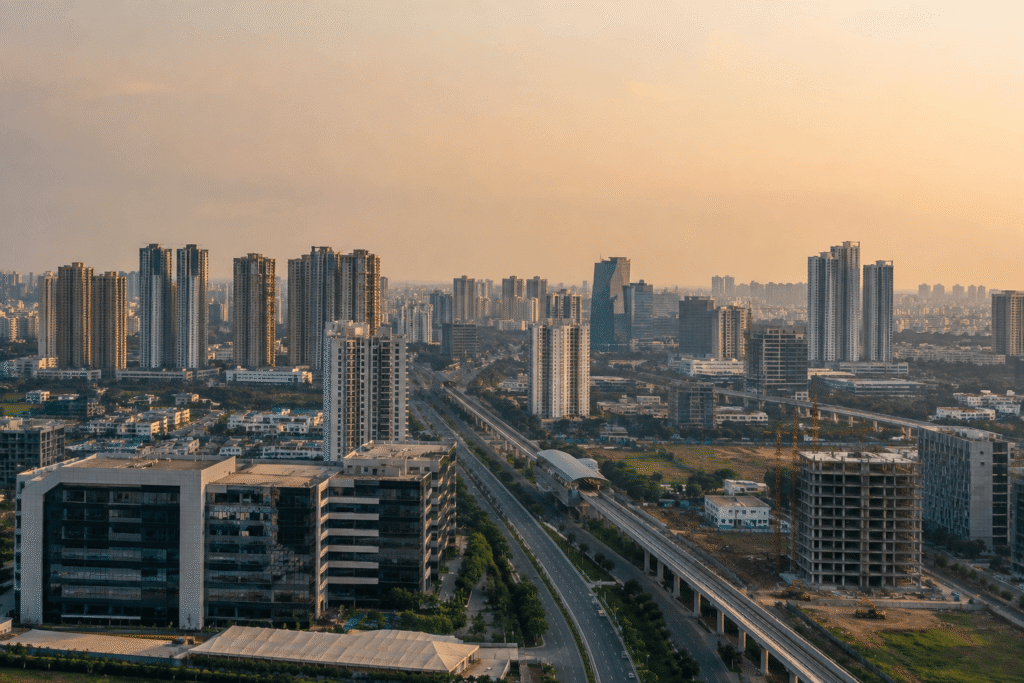
Key Takeaways The Gurgaon property market in 2026 reflects a mix of strong fundamentals, higher valuations, and selective risks across micro-markets. Every time a Gurgaon micro-market posts a headline-grabbing price jump, the same question resurfaces on investor forums and WhatsApp groups: is this growth real, or is Gurgaon just the next market waiting to correct hard? A balanced answer requires looking beyond recent price growth and examining the fundamentals supporting demand, along with the risks that could affect future performance. This analysis examines what constitutes a real estate bubble and evaluates Gurgaon against those criteria, and crucially, does not ignore the more complex aspects of the story that lend themselves to a “this is normal” narrative. Whether you’re considering purchase, hold, or wait decisions, you need the uncomfortable data points just as much as the reassuring ones. Quick Answer Gurgaon does not currently show signs of a city-wide real estate bubble in 2026. Strong employment growth, infrastructure expansion, and end-user demand continue to support the market. However, some micro-markets have experienced unusually rapid appreciation, rental yields remain modest, and buyers should evaluate individual projects rather than the city as a whole. Metric Current Status Bubble Risk Low city-wide End-user Demand Strong Rental Yield Moderate (2–3%) Infrastructure Expanding Oversupply Limited Investment Horizon 5–10 years What Actually Defines a Real Estate Bubble? A property bubble forms when prices rise significantly beyond what underlying fundamentals such as income levels, rental returns, and genuine housing demand can justify. The usual warning signs include: Most historical property bubbles from the US in 2008 to parts of China more recently showed several of these at once. The relevant question for Gurgaon isn’t whether prices have risen fast (they have), but whether that rise is backed by real demand or mostly by speculation. Does Gurgaon Show Bubble Characteristics Today? Indicator Healthy Market Bubble Market Gurgaon (2026) End-user demand High Low High Rental demand Strong Weak Strong, but yields modest Infrastructure Expanding Weak/stagnant Expanding Speculative buying Moderate Very high Moderate, higher in select sectors Supply Balanced Oversupplied Broadly balanced Price volatility Low-moderate High, sharp reversals Moderate; one correction already seen in 2025 City-wide, Gurgaon lands closer to “healthy” than “bubble” on most indicators. But two rows in that table deserve more scrutiny than a simple checkmark, so these indicators require closer examination rather than a simple conclusion. Are Gurgaon Rental Yields Good in 2026? Residential rental yields in Gurgaon are generally estimated to range between 2% and 3% across many residential segments, according to industry research published by organizations such as Knight Frank, JLL, CBRE, and ANAROCK. While these yields are relatively modest compared to the city’s long-term capital appreciation potential, and lower than those typically seen in many commercial real estate assets, they do not, by themselves, indicate a property bubble. Investors focused on rental income should assess location-specific rental demand, vacancy rates, maintenance costs, and future growth prospects before making an investment decision. Low rental yield alone doesn’t prove a bubble; it’s normal in high-appreciation markets, where investors accept lower current income in exchange for capital growth. But it does mean Gurgaon residential property isn’t currently a strong pure income play, and any analysis that leans entirely on “rental demand is strong” without mentioning the yield number is giving you half the picture. If your primary goal is rental income rather than capital appreciation, rental yield should be one of the first metrics you evaluate, along with vacancy risk, maintenance costs, and future demand. Did Gurgaon Property Prices Correct Before 2026? The idea that Gurgaon property prices only move upward does not fully reflect recent market behaviour. After significant appreciation between 2021 and 2024, some residential segments experienced price moderation during 2025 as buyers became more selective and affordability pressures increased. The correction was not uniform across Gurgaon. Established premium locations, infrastructure-led corridors, and high-demand projects showed greater resilience, while some rapidly appreciated pockets saw more noticeable price adjustments. This moderation does not indicate a market collapse. Instead, it highlights that Gurgaon has entered a more mature phase where valuations are being tested against fundamentals such as employment growth, infrastructure delivery, supply discipline, and genuine end-user demand. A market capable of absorbing slower growth or limited corrections is different from one driven purely by speculative momentum. Why Have Gurgaon Property Prices Increased? The rise in prices over the past five years can be attributed to several real (rather than speculative) factors. Infrastructure Expansion The connectivity upgrade has significantly altered the commutable area of Gurgaon and consequently, also the demand for it, which is the fastest among all factors. Key developments include: Employment Growth Gurgaon remains one of India’s leading corporate hubs, with offices of multinational companies, technology firms, consulting firms, financial institutions, and Global Capability Centres. This results in a continuous, real demand for housing by professionals relocating for employment, as opposed to speculative buyers, who look to resell the home within months. Limited Premium Supply In general, developers have introduced premium inventory piecemeal, rather than introducing the market on a large scale, which has limited supply in key luxury corridors and allowed for a real, although limited, increase in prices. Rising Construction Costs Material inflation, labour costs, and higher construction and compliance standards have pushed up development costs industry-wide, which shows up directly in new-launch pricing. Some of today’s higher prices simply reflect what it costs to build now, not speculative markup. Which Gurgaon Areas Offer the Best Long-Term Investment Potential? Not every part of Gurgaon tells the same story, and lumping them together is where a lot of bubble commentary goes wrong. Corridors with strong appreciation backed by fundamentals: Gurgaon Real Estate Outlook by Corridor (2026) Corridor Market View Key Driver Dwarka Expressway Growth corridor Connectivity + new development SPR High-growth zone Commercial expansion Golf Course Extension Road Premium established market Luxury demand New Gurgaon Value growth corridor Affordability + infrastructure Golf Course Road Mature premium market Corporate demand Pockets worth more caution: Some Gurgaon micro-markets have significantly outperformed the city average due