Is Dwarka Expressway Overpriced in 2026? A Data-Driven Buyer Guide
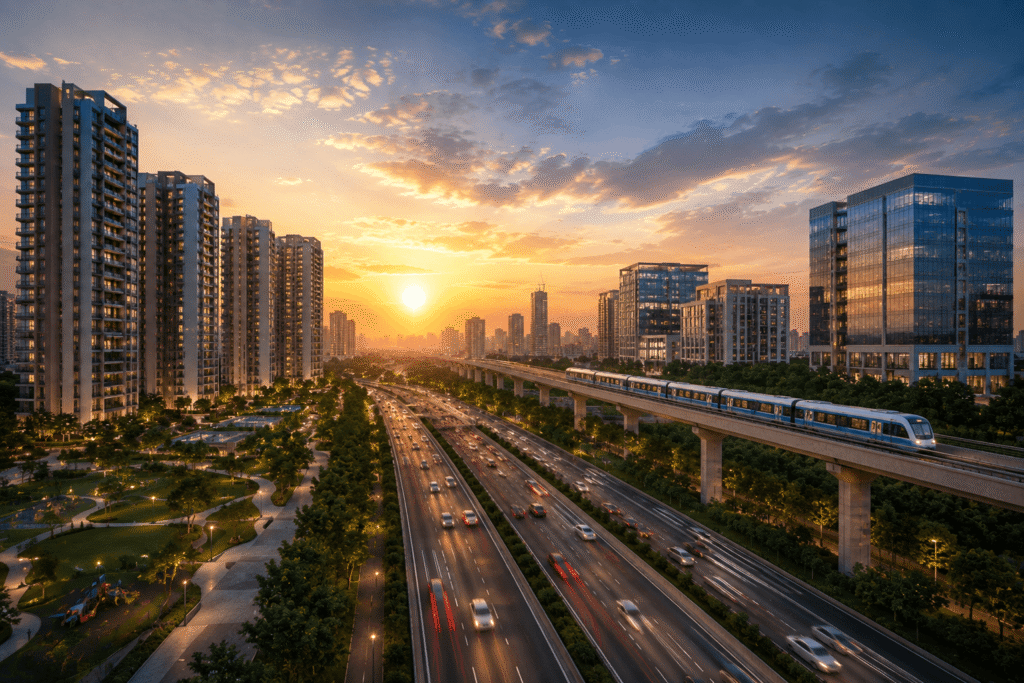
Property prices on this corridor are undeniably higher than their historical levels, but “overpriced” is a verdict that needs a project name attached to it, not a blanket label for the whole stretch. Rates swing by more than ₹8,000 per sq ft between sectors, so the real question isn’t whether the corridor is expensive. It’s whether the specific property you’re looking at earns its price. Quick Answer This corridor as a whole is not uniformly overpriced, though individual projects can be. Housing.com’s 2026 locality data puts the average price at roughly ₹12,688 per sq ft, with sector averages ranging from about ₹11,098/sq ft in Sector 37D to ₹19,307/sq ft in Sector 36A, and a reported 3.52% year-on-year rise. MagicBricks’ Q2 2026 data shows a higher multi-storey apartment benchmark of roughly ₹14,661/sq ft, but a quarter-on-quarter dip of about -1%, suggesting the market isn’t rising evenly across the corridor. The honest answer: it depends entirely on which sector and which project you’re comparing. Why “Is Dwarka Expressway Overpriced?” Is the Wrong Question This corridor isn’t one market; it’s a collection of very different micro-markets sharing one address. A resale apartment at ₹11,000/sq ft and a branded luxury tower at ₹19,000/sq ft can both sit on the same road, and neither price tells you much about the other. That’s why the more useful question isn’t “Is Dwarka Expressway expensive?“ It’s: at this price, am I getting enough location, connectivity, rental demand, project quality, and future growth to justify what I’m paying? Dwarka Expressway Property Prices by Sector (2026) Sector Approx. 2026 Average Rate 37D ₹11,098/sq ft 103 ₹11,243/sq ft 109 ₹12,366/sq ft 108 ₹13,439/sq ft 102 ₹13,831/sq ft 104 ₹14,563/sq ft 112 ₹14,614/sq ft 106 ₹14,731/sq ft 111 ₹15,560/sq ft 113 ₹16,969/sq ft 36A ₹19,307/sq ft Source: Housing.com locality-level data, reviewed July/August 2026. That’s a spread of more than ₹8,000 per sq ft from the cheapest to the priciest sector, roughly a 74% gap. A ₹2 crore resale buyer and a ₹6 crore luxury buyer are effectively shopping in two different markets that happen to share a highway. Why Do People Call Dwarka Expressway Overpriced? 1. Prices have climbed sharply from where they started The corridor was formerly marketed almost entirely on future promise, on infrastructure that had not yet arrived. That promise has been mostly fulfilled: NHAI confirms that the 19km, eight-lane Haryana stretch was thrown open in March 2024, from the Delhi-Haryana border (Basai railway overbridge) to Kherki Daula, with further access to IGI Airport and the Gurugram bypass. As the infrastructure materialized, prices moved with it. The catch for today’s buyer is straightforward: you’re not entering the same market an early investor entered. Some of the appreciation that used to sit ahead of the market may already be baked into current asking rates. 2. Luxury-project pricing distorts the average in people’s heads It’s easy to mistake a handful of headline-grabbing luxury listings for the corridor’s typical price. They’re not the same thing. Current Housing.com listings (reviewed July 2026) show just how wide this gap runs: These are asking prices from active listings, not confirmed transactions, and individual units vary by floor, view, construction stage, and applicable charges. The point stands regardless: one expensive tower doesn’t make the whole corridor overpriced; it just makes that tower expensive. 3. Future growth may already be priced into some projects This is the sharper question for anyone thinking like an investor. When a location is still undeveloped, early buyers can get in before infrastructure and demand fully mature. Once the roads, connectivity, and large residential projects are already built, the price starts reflecting expectations about future development too, not just what exists today. Earlier investor 2026 investor Entry price Lower Higher Infrastructure certainty Low High Upside potential Higher, but riskier More moderate, less risky Prices can absolutely rise further from here. The point is simply that buyers today need to be more deliberate about what they’re paying now for growth that may or may not still be ahead of them. Is Dwarka Expressway Still Undervalued? There’s a real case on both sides. The case for further growth: improving Delhi–Gurugram connectivity, proximity to IGI Airport, a large residential pipeline, expanding commercial development, access to established Gurugram employment hubs, and continued developer activity. A May 2026 Times of India report, citing a joint India Sotheby’s International Realty–CRE Matrix study, described the corridor’s shift from a peripheral market toward a more integrated urban growth zone, backed by substantial value growth. The case for caution: supply is the biggest risk factor. Housing.com listed more than 4,900 flats for sale on its corridor listings page in July 2026, alongside over 2,000 new projects and thousands of resale listings. That’s not the full future pipeline, but it shows how much inventory buyers already have to choose from, and when buyers have that much choice, sellers have less room to hold pricing firm, especially if end-user demand doesn’t keep pace with new supply. The Real Trap: Asking Price vs. Actual Value An advertised rate of ₹18,000 per sq ft doesn’t automatically mean the property is worth ₹18,000 per sq ft. Before you take a headline number at face value, work through: The effective acquisition cost, not the marketing headline, is what determines whether a property is fairly priced. A 3-Step Test to Check If a Property Is Overpriced 1. Find comparable market pricing: Shortlist at least three properties in the same sector with a similar configuration, size, possession status, construction quality, developer reputation, and location within the sector. Don’t compare a five-year-old resale flat against a newly launched branded tower just because both sit in Sector 106. 2. Calculate the effective acquisition cost: A builder quoting ₹15,000 per sq ft on a 2,000 sq ft saleable-area apartment gives you a headline figure of ₹3 crore (₹15,000 × 2,000). But GST, where applicable, stamp duty, registration, parking, PLC, floor-rise, club charges, and maintenance deposits can push the real number meaningfully higher. 3. Test the income and resale case: Ask who’s realistically buying